FREE NEWSLETTER

Money inherited is money that wasn’t worked for. Don’t be surprised if it gets squandered.
HOW DO YOU COMPETE in an investment contest when you’re a firm believer that investors can’t consistently beat the market averages? That was my dilemma several years ago.
A school not far from where I taught was given money by an alumnus to endow the St. Louis Area Collegiate Investment Contest. All colleges and universities in the area are invited to participate in the competition, which is held regularly. Each is given a hypothetical $1 million and asked to select 20 value stocks. An outside investment firm oversees the contest. They “invest” $50,000 in each of the 20 stocks. Whoever’s portfolio is worth the most two years later wins $10,000—real dollars, that is.
How do we select the 20 stocks for our entry? When I explain the contest to students, I also discuss the evidence that most investors don’t outperform the market. I suggest we could tape the stock pages of The Wall Street Journal to the wall and literally throw darts at it. Several students like this option.
But instead, I distribute Value Line’s current list of 100 stocks most likely to outperform the stock market over the next year. To focus on value stocks, I take these 100 stocks deemed most likely to outperform, circle the 40 or so companies with the lowest price-earnings ratios and ask students to select stocks from this list.
Value Line Investment Survey, which is often available at larger libraries, evaluates approximately 1,700 stocks. Value Line gives each stock a timeliness rating from one to five, indicating its belief that the stock will outperform the market over the next year. My initial list for the students draws on those stocks rated one for timeliness.
Rating Number of Stocks Meaning
1 100 Most likely to outperform
2 300
3 900
4 300
5 100 Least likely to outperform
Value Line has a full-page analysis of each of these 1,700 stocks. Each stock gets a full review every 13 weeks, which means each week it updates this detailed analysis for about 130 stocks. But each week, all 1,700 stocks are evaluated for timeliness.
Some 30 or 40 years ago, there were a few academic studies indicating that Value Line could outperform the market averages. I have seen no recent independent studies of Value Line. My guess is that any advantage Value Line might have had decades ago no longer exists.
While I don’t believe Value Line will outperform the market, it’s one way to narrow down the list of potential stocks. It’s definitely safer than letting college students throw darts in a classroom.
Six schools entered the first contest. We won, receiving $10,000 and an oversized check. I took the check to our next faculty meeting and bragged about our business students. Most faculty assumed I had superior stock-picking skills, and I did not disabuse them of that view. But in my heart, I firmly believed it was just luck.
Six years later, we won again. If six schools enter each year, we ought to win about every six years. I didn’t point out that obvious fact when I went to the faculty meeting with that oversized check.
The very next year, we won again. Did that indicate we had a winning method? No. If six schools enter, and if the winner is completely random, the chance of this year’s winner winning again next year is one out of six. While my method of picking stocks might be superior, I believe two wins in a row is simply a random occurrence.
Recently, the contest was modified. Instead of starting just once a year, it now starts every semester. The payoff for winning was reduced from $10,000 once a year to $5,000 each semester. The number of participating schools has dropped to just four or five, increasing our odds of winning each contest.
Although I'm now retired, our school continues to follow the above method. Over the years, we have won $35,000. We call it our slush fund. Our department has used that money for additional faculty enrichment opportunities, student awards, end-of-the-year catered dinners for graduates and their families, and a host of other good causes. Perhaps most important, our finance students have learned some important lessons about how the stock market works.
 Larry Sayler is the only person with a Wharton MBA who also graduated from Ringling Bros. and Barnum & Bailey’s Clown College. Earlier in his career, he served as CFO for three manufacturing and service organizations. For 16 years before his retirement, Larry taught accounting at a small Christian college in the Midwest. His brother Kenyon also writes for HumbleDollar. Check out Larry's earlier articles. [xyz-ihs snippet="Donate"]
IF YOU HAVE a Money Market Fund (e.g. VUSXX, VMFXX), Treasury fund (e.g. SGOV), or any other Treasury ETF (e.g. VBIL), you need to know how to report it on your taxes correctly. If you don’t, you are overpaying on your state taxes unknowingly.
How and why?
These funds hold U.S. Treasury Bills. Treasuries are exempt from state and local taxes. Of course, this only matters if you hold these funds in a taxable brokerage account, which most people do.
The broker sends you a 1099-DIV form, but it’s your responsibility to figure out how to report it on your taxes correctly. By the way, bad tax preparers can miss this sometimes, or if you self-prepare, this may be something you aren't aware of (I hope most of you reading HumbleDollar are familiar with this!)
This is one of those areas where the reporting rules are technically simple, but the execution is where people mess up. The IRS gets their share regardless (since interest is fully taxable at the federal level), but if you don’t adjust properly, your state will too, even when it shouldn’t.
The 1099-DIV doesn’t break out how much of the dividend was allocated to Treasuries. The software also wouldn’t know how much based on the 1099-DIV. This means that you generally have to figure out how to report it (or ensure your CPA does it correctly).
Now, the 1099-DIV will have a breakdown of every single stock/ETF you have, but you have to find out the percentage of a fund that holds Treasuries.
This percentage is not on your brokerage statement. It comes directly from the fund provider (Vanguard, iShares, Schwab, etc), usually buried in their “tax center” or “year-end tax supplement” pages.
Let me give you an actual example.
Say, in 2025, you received $5,000 of dividends from two funds.
Then, if you scroll down, you will see a “Detail Information” of your dividends:
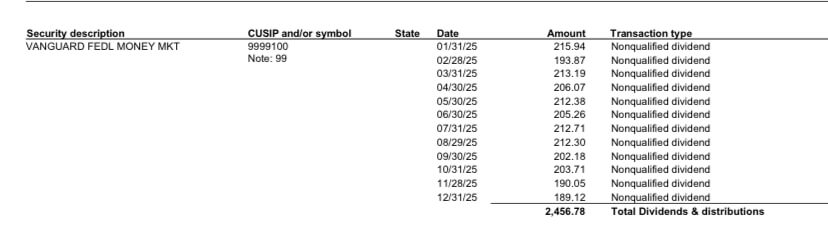
We can see that $2,456.78 came from Vanguard Federal Money Market fund.
The entire $2,456.78 will be taxed at the federal level, but how do we figure out what’s taxed at the state level?
This is where the extra step comes is.
During the end of the year, the fund manager (e.g Vanguard for VMFXX) will post a “US government source income information” on their Tax page.
This report tells you what portion of the fund’s income is derived from U.S. government obligations (Treasuries), which is the key to the state tax exemption.
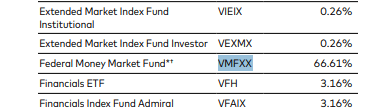
We can see that 66.61% of VMFXX holdings for the 2025 tax year were income derived from the U.S. government and, therefore, are not taxable at the state level.
So, we would take $2,456.78 * 0.6661 = $1,636. Of the total, $1,636 is derived from U.S. obligations, and you would only pay state taxes on the remaining ~$819.
That $2,456.78 is still fully taxable federally. This is strictly a state adjustment.
It’s also important to note that some states say "if less than 50% of the fund is from the U.S. government (like Treasury Bills), you can treat it as 0%.”
For example, California, Connecticut, and New York are some of these states. So, if the fund has only 35% coming from the Treasury, you shouldn’t even calculate the exempt amount for these states.
Now, if you buy Treasuries directly from TreasuryDirect, they will send you a 1099-INT, and you can just enter that information directly into the tax software. No extra calculations are needed. That’s because the income is already clearly identified as U.S. government interest, no allocation required.
So, how do you report that dividend interest calculation?
In most tax softwares, after entering the 1099-DIV, it will ask: "Did a portion of dividends came from a U.S. Government interest?'
So, you would just check it off/select and enter the amount from Treasuries ($1,636 in our example).
Behind the scenes, this flows into your state return as a subtraction or adjustment, depending on the state.
Some software might ask for the percentage of dividends that are state tax exempt. However, this is a bit tricky because you might receive other dividends in your brokerage account.
In that case, calculate the amount from the Treasury, say $1,636, and divide it by your total dividend amount (e.g. $5,000)
If you have someone do your taxes and you have some of these Money Market Funds or other Treasury ETFs, double-check your state tax return and see the amounts reported. This will save you some money. It's also not too late to amend your tax return if this was missed.
Specifically, look for a “U.S. government interest subtraction” or similarly labeled line item on your state return. If it’s zero and you held these funds, that’s a red flag.
If you live in a no tax state, this would not apply to you, but still good to know in case you move!
I hope you found this one valuable.
 Bogdan Sheremeta is a licensed CPA based in Illinois with experience at Deloitte and a Fortune 200 multinational.
NO. 2: WE GET one shot at making the financial journey from here to retirement—and failure is not an option, so we should save like crazy, avoid big investment bets and insure against major risks.
NEGATIVE BONDS. When we buy bonds, we lend to others and receive interest in return. Borrowing can be seen as a negative bond: Others lend to us—and we pay them interest. Typically, the interest rate we pay on borrowed money is higher than the yield we can earn by buying bonds. The upshot: Paying down debt is often the smartest “bond” we can buy.
NO. 2: WE FOCUS on today—and shortchange tomorrow. Our nomadic ancestors didn’t worry about the long term. Instead, they focused on surviving today, which meant consuming as much as they could whenever they could. Those instincts live on within us, driving our spending, saving and investing behavior—and causing long-term financial damage.
CHECK YOUR retirement readiness. Try the simple calculators from AARP and Vanguard Group. Neither requires you to create an account. Each will give you a somewhat different assessment—a reminder that such projections are a rough-and-ready business. Still, you should get a sense for whether you're on track for a comfortable retirement or off the rails.

NO. 2: WE GET one shot at making the financial journey from here to retirement—and failure is not an option, so we should save like crazy, avoid big investment bets and insure against major risks.
THE ONLY DREAM I HAD for my son was that he’d get a job. To most parents, this probably seems like small thinking. Why wasn’t I dreaming of him walking across the stage after earning his medical degree, or walking down the aisle with his new bride, or the joy of him holding his first child? Because that would not be his reality.
It took me a while to accept this. Based on my life,
Ran across this. Not HD content or indeed probably the average HDer being discussed but interesting on the general problems faced by over 60s
https://sherwood.news/personal-finance/boomers-money-secrets-millennial-gen-z-troubles/
I’ve always thought inheritance would eventually be the only way many of their grandkids would achieve real financial security but it seems some may be passing on a millstone in legacy.
FATHERHOOD WASN’T one of my life goals. I didn’t feel like I had a wonderful childhood, so I didn’t think I had much to offer my offspring that would help them to lead a wonderful life. If children happened, okay, but it was never a goal.
My first marriage ended because I placed money over fatherhood. I thought not having kids would speed my path to wealth. My wife disagreed—and walked out.
When I met my current wife,
“YOU WILL ROTH!”
“But Dad, I’m only 10.”
“Evan, it is never too early to start saving. Besides, this gives you 70-plus years of compounding.”
“Yes, Dad, but didn’t you tell me last week that I need a job and earned income to contribute to a Roth?”
“We can arrange to get you a paycheck. I’ll get a friend or neighbor to hire you. What would you like to do?”
“I like to play soccer.”
“Evan,
I want to thank Jonathan Clements for his article on allowances for children many years ago while I was raising my children. After reading the article I decided to give my two children age 13 and 5 at the time a monthly allowance. For this allowance they had to buy their own clothing. My daughter at age 13 was initially appalled at having to buy her own clothes. We did agree that we would buy big clothing items such as a.
As I read through the comments and posts on HD I often see a comment related to a spouse’s employment/retirement. Is a two income family as common as it appears to be?
How does a dual income impact financial and retirement planning? Is it easier or more complicated? Are family finances viewed as one pool or separate?
Are there conflicts when one spouse retires while the other works?
Are financial/Investment decisions made by individual or as one portfolio?




For Richer, For Poorer: 37 Years of Compounding
Mark Crothers | Apr 28, 2026
California, Here They Came
D.J. | Apr 29, 2026
The Vision, the Babe , Einstein and the Q
mflack | Apr 25, 2026
How Far Behind is the IRS?
Larry Sayler | Apr 29, 2026
Note to HD Writers and Contributors
Elaine M. Clements | Apr 3, 2026
Shopping around – you versus the grocery store
R Quinn | Apr 30, 2026
Somebody Has to Win
ArticleLarry Sayler | Oct 31, 2023
HOW DO YOU COMPETE in an investment contest when you’re a firm believer that investors can’t consistently beat the market averages? That was my dilemma several years ago.
A school not far from where I taught was given money by an alumnus to endow the St. Louis Area Collegiate Investment Contest. All colleges and universities in the area are invited to participate in the competition, which is held regularly. Each is given a hypothetical $1 million and asked to select 20 value stocks. An outside investment firm oversees the contest. They “invest” $50,000 in each of the 20 stocks. Whoever’s portfolio is worth the most two years later wins $10,000—real dollars, that is.
How do we select the 20 stocks for our entry? When I explain the contest to students, I also discuss the evidence that most investors don’t outperform the market. I suggest we could tape the stock pages of The Wall Street Journal to the wall and literally throw darts at it. Several students like this option.
But instead, I distribute Value Line’s current list of 100 stocks most likely to outperform the stock market over the next year. To focus on value stocks, I take these 100 stocks deemed most likely to outperform, circle the 40 or so companies with the lowest price-earnings ratios and ask students to select stocks from this list.
Value Line Investment Survey, which is often available at larger libraries, evaluates approximately 1,700 stocks. Value Line gives each stock a timeliness rating from one to five, indicating its belief that the stock will outperform the market over the next year. My initial list for the students draws on those stocks rated one for timeliness.
Rating Number of Stocks Meaning
1 100 Most likely to outperform
2 300
3 900
4 300
5 100 Least likely to outperform
Value Line has a full-page analysis of each of these 1,700 stocks. Each stock gets a full review every 13 weeks, which means each week it updates this detailed analysis for about 130 stocks. But each week, all 1,700 stocks are evaluated for timeliness.
Some 30 or 40 years ago, there were a few academic studies indicating that Value Line could outperform the market averages. I have seen no recent independent studies of Value Line. My guess is that any advantage Value Line might have had decades ago no longer exists.
While I don’t believe Value Line will outperform the market, it’s one way to narrow down the list of potential stocks. It’s definitely safer than letting college students throw darts in a classroom.
Six schools entered the first contest. We won, receiving $10,000 and an oversized check. I took the check to our next faculty meeting and bragged about our business students. Most faculty assumed I had superior stock-picking skills, and I did not disabuse them of that view. But in my heart, I firmly believed it was just luck.
Six years later, we won again. If six schools enter each year, we ought to win about every six years. I didn’t point out that obvious fact when I went to the faculty meeting with that oversized check.
The very next year, we won again. Did that indicate we had a winning method? No. If six schools enter, and if the winner is completely random, the chance of this year’s winner winning again next year is one out of six. While my method of picking stocks might be superior, I believe two wins in a row is simply a random occurrence.
Recently, the contest was modified. Instead of starting just once a year, it now starts every semester. The payoff for winning was reduced from $10,000 once a year to $5,000 each semester. The number of participating schools has dropped to just four or five, increasing our odds of winning each contest.
Although I'm now retired, our school continues to follow the above method. Over the years, we have won $35,000. We call it our slush fund. Our department has used that money for additional faculty enrichment opportunities, student awards, end-of-the-year catered dinners for graduates and their families, and a host of other good causes. Perhaps most important, our finance students have learned some important lessons about how the stock market works.
One World, One Kind of Work
Andrew Clements | Apr 30, 2026
Treasury Tax Reporting
ArticleBogdan Sheremeta | Mar 28, 2026
IF YOU HAVE a Money Market Fund (e.g. VUSXX, VMFXX), Treasury fund (e.g. SGOV), or any other Treasury ETF (e.g. VBIL), you need to know how to report it on your taxes correctly. If you don’t, you are overpaying on your state taxes unknowingly.
How and why?
These funds hold U.S. Treasury Bills. Treasuries are exempt from state and local taxes. Of course, this only matters if you hold these funds in a taxable brokerage account, which most people do.
The broker sends you a 1099-DIV form, but it’s your responsibility to figure out how to report it on your taxes correctly. By the way, bad tax preparers can miss this sometimes, or if you self-prepare, this may be something you aren't aware of (I hope most of you reading HumbleDollar are familiar with this!)
This is one of those areas where the reporting rules are technically simple, but the execution is where people mess up. The IRS gets their share regardless (since interest is fully taxable at the federal level), but if you don’t adjust properly, your state will too, even when it shouldn’t.
The 1099-DIV doesn’t break out how much of the dividend was allocated to Treasuries. The software also wouldn’t know how much based on the 1099-DIV. This means that you generally have to figure out how to report it (or ensure your CPA does it correctly).
Now, the 1099-DIV will have a breakdown of every single stock/ETF you have, but you have to find out the percentage of a fund that holds Treasuries.
This percentage is not on your brokerage statement. It comes directly from the fund provider (Vanguard, iShares, Schwab, etc), usually buried in their “tax center” or “year-end tax supplement” pages.
Let me give you an actual example.
Say, in 2025, you received $5,000 of dividends from two funds.
Then, if you scroll down, you will see a “Detail Information” of your dividends:
We can see that $2,456.78 came from Vanguard Federal Money Market fund.
The entire $2,456.78 will be taxed at the federal level, but how do we figure out what’s taxed at the state level?
This is where the extra step comes is.
During the end of the year, the fund manager (e.g Vanguard for VMFXX) will post a “US government source income information” on their Tax page.
This report tells you what portion of the fund’s income is derived from U.S. government obligations (Treasuries), which is the key to the state tax exemption.
We can see that 66.61% of VMFXX holdings for the 2025 tax year were income derived from the U.S. government and, therefore, are not taxable at the state level.
So, we would take $2,456.78 * 0.6661 = $1,636. Of the total, $1,636 is derived from U.S. obligations, and you would only pay state taxes on the remaining ~$819.
That $2,456.78 is still fully taxable federally. This is strictly a state adjustment.
It’s also important to note that some states say "if less than 50% of the fund is from the U.S. government (like Treasury Bills), you can treat it as 0%.”
For example, California, Connecticut, and New York are some of these states. So, if the fund has only 35% coming from the Treasury, you shouldn’t even calculate the exempt amount for these states.
Now, if you buy Treasuries directly from TreasuryDirect, they will send you a 1099-INT, and you can just enter that information directly into the tax software. No extra calculations are needed. That’s because the income is already clearly identified as U.S. government interest, no allocation required.
So, how do you report that dividend interest calculation?
In most tax softwares, after entering the 1099-DIV, it will ask: "Did a portion of dividends came from a U.S. Government interest?'
So, you would just check it off/select and enter the amount from Treasuries ($1,636 in our example).
Behind the scenes, this flows into your state return as a subtraction or adjustment, depending on the state.
Some software might ask for the percentage of dividends that are state tax exempt. However, this is a bit tricky because you might receive other dividends in your brokerage account.
In that case, calculate the amount from the Treasury, say $1,636, and divide it by your total dividend amount (e.g. $5,000)
If you have someone do your taxes and you have some of these Money Market Funds or other Treasury ETFs, double-check your state tax return and see the amounts reported. This will save you some money. It's also not too late to amend your tax return if this was missed.
Specifically, look for a “U.S. government interest subtraction” or similarly labeled line item on your state return. If it’s zero and you held these funds, that’s a red flag.
If you live in a no tax state, this would not apply to you, but still good to know in case you move!
I hope you found this one valuable.
Is saving really that hard? Nope, not for the great majority of Americans.
R Quinn | Apr 28, 2026
The great COLA debate-maybe not the expected solution.
R Quinn | Apr 26, 2026
Happy 50th!
Rick Connor | Apr 27, 2026