FREE NEWSLETTER

TRUMP ACCOUNT WAS created as part of the OBBBA signed on July 4, 2025. I’ve been getting a lot of messages about it, because there is a lot of conflicting information. The IRS has also posted some instructions for the account.
My goal with this post is to walk through the rules and give my take on when (if ever), this account makes sense.
Timing & Creation
First and foremost, no contributions are allowed in this savings account for children until 12 months after the law’s enactment, meaning you can’t use it or invest in one until July 5, 2026.
However, you can start signing up for it.
There are 2 main ways:
1. File Form 4547
You can file Form 4547 with your tax return to open an account for your beneficiary. This is the safest and easiest way to make the election to open the account.
This is also where you can get a $1,000 pilot program credit if your child qualifies (more on this in a bit)
2. File Form 4547 via TrumpAccounts.Gov
You may use the .gov website to file Form 4547 electronically:
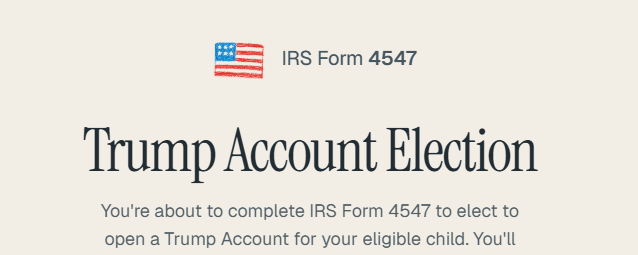
Personally, if you plan to open one, I recommend filing Form 4547 with your tax return, which I believe is a more secure way to submit the election.
General
A Trump Account is treated like a traditional IRA under Section 408(a) (not Roth), with some modifications. It is created for the exclusive benefit of an individual who:
Contributions
There are 2 types of contributions: exempt and non-exempt (regular)
1. Non exempt contributions
Up to $5,000/year can be contributed by parents, grandparents, or even relatives, until the child turns 18, starting in July 2026. Importantly, there will be NO tax deduction for contributing to this account.
2. Exempt contributions:
You may have heard about employers pledging to put some amounts in their employees accounts. Companies like Nvidia, Citi, BoA, IBM, Chase, Visa and many others pledged to contribute to these accounts for their employees’ children. This is great because it’s “free” money for them.
Parents/guardians elect for an “eligible child” (U.S. citizen born Jan. 1, 2025, through Dec. 31, 2028) to receive $1,000 as a seed contribution. This is an election you can file as part of the Form 4547. Note that even though your child may not qualify for the $1,000, you can still open the account using Form 4547.
Governments or nonprofits can also contribute for certain minors based on some qualifications (e.g. county deposits $1,000 for all minors living in that county).
You may have seen a charitable commitment from the Dells of $6.25B. As part of the commitment, the first 25 million American children age 10 and under living in ZIP codes with median incomes below $150,000 will receive an additional $250 contributed to the account.
Exempt contributions aren’t part of the “basis” which becomes important for withdrawals.
Investments
Funds must be invested in eligible index mutual funds or ETFs that:
I like this requirement because it keeps investing simple and minimizes fees.
Distributions
No withdrawals are allowed before age 18 (except for rollovers or excess contributions).
After 18, the account functions like a traditional IRA. This means that when you withdraw the money, the growth is taxed as ordinary income when withdrawn.
After the growth period (that is, starting January 1st of the calendar year in which the child turns 18), most of the
rules that apply to traditional IRAs will generally apply to the Trump account. For example, this means that
distributions from the Trump account could be subject to the section 72(t) 10% additional tax on early distributions, unless an exception applies (like higher qualified education expenses or $10k for first home downpayment)
Example
Say you, as a parent, contributed $5,000 to this account. You did not receive any tax deduction for this contributions. Your child also received $1,000 from the pilot program, since your child was born between 2025-2028. At 18, the account grew to $22,000.
Withdrawals at 18 are pro rata. If you take $10,000 to pay for college, ~$2,272 would be from the basis (non-taxable) and ~$7,727 would be taxable earnings.
You would pay taxes on $7,727 based on the marginal tax rate. A 10% penalty will not apply, since an exception applies (see a full list of exceptions here)
Benefits
I believe the main usefulness of this account is the Roth IRA play. Of course, get the $1,000 pilot contribution or any other “free” benefits. But making direct contributions to the account may not be the best choice, especially if you are limited on funds.
For ongoing contributions, a 529 plan will likely come out ahead for most families. This is because the withdrawals are tax free for education, you can often claim a state tax deduction, and OBBBA expanded qualified expenses on 529 plans to include expenses like SAT/AP exams costs and postsecondary credentials. You can also convert up to $35,000 to a Roth IRA from a 529 plan.
However, wealthier parents may find contributing to the account and making a Roth conversion a strategic choice.
What do you think of this account?
 Bogdan Sheremeta is a licensed CPA based in Illinois with experience at Deloitte and a Fortune 200 multinational.



Can it be converted tax free to a Roth at age 18??
Earnings count as ordinary income but may well be taxed at 0% for an 18-year-old.
Trump Account contribution from govt is for babies 2026-2030
IRC 530A accounts may succeed at creating middle class millionaires … someday.
The average annual rate of return since the end of WWII has been about 11.17% per year. Investing $1,000 at birth today in a tax deferred account @ 11.17%, results in an account worth slightly more than $2.5 million at required minimum distribution age 75.
People who have children are, by definition optimists.
My understanding is:
Don’t leave your child behind … just in case history repeats itself.
Thanks for the article. I am an AARP tax preparer and today this is out of scope for our preparers. I will give it a year to fully cook and see how the details pan out. My early read showed some conflicting instructions. Maybe it can be something I can consider for my grandkids.
I’m confused. Who owns the Trump Account – the child, the parent(s), the contributors?
Why did a sincere question score down arrows?
As I understand it, the child is the legal owner of the account, but the parent or guardian is the custodian.
Bogdan – Thanks for this analysis. I have done some research and think the UGMA is a better way to go even though it would be counted as part of a FAFSA filing for college.
Bogdan, thanks for this information, this is a great explanation of the program, and related strategies to help take full advantage, however….
As a whole, middle class working families trying to feed and educate the kids, fund their 401k, feed an HSA and keep a roof over their heads won’t be able to use this to their full advantage.
Interesting concept, but at the end of the day, I feel it’s just more ‘chicken in every pot’ politics that runs up the national debt.
This sounds like it could be a useful tool. But I don’t want anything named Trump in my portfolios!
I would encourage the reading of the linked Morningstar article about this subject matter.
Thank you for the article! Can you please expand on the “Roth IRA play” you reference? Are conversions also pro-rata? TIA
Under the preliminary rules Trump Accounts are scheduled to convert to traditional IRAs in the year the beneficiary attains age 18 which would allow the beneficiary the option to convert all or part of the account to a Roth IRA with little or no tax due.
I would expect the relevant tax rules will change by 2044 and I also expect I will not still be alive to have to worry about them. I would consider any future pro-rata requirement question to be a to be determined by someone else matter.
For parents (or grandparents) with means the Trump Accounts could be a huge wealth hack. Even if your (grand)kids aren’t eligible for the free $1000, you can fund these accounts for minors up to $5000 per year.
Then, when the kid turns 18 you convert to a Roth over one or more years using the child’s standard deduction to shield any taxes owed on the growth. You’ve effectively seeded a Roth IRA of up to $90,000 (not including growth)–all without the child ever needing earned income (the usual Roth contribution requirement).
That early Roth will grow handsomely by the time the kid reaches retirement age.
I think, like past actions in this area it is unnecessary, it is too complicated, will be underused and when used, not by the people who could most benefit, but higher income Americans, many who don’t need another tax break.
In connection with my earlier comment about the historical UK equivalent to the Trump accounts, evidence suggests the majority of forgotten accounts belong to people in lower economic circumstances. More affluent families used them as intended, making regular contributions, while those on lower incomes never added to them — and so they were simply forgotten.
Kind of like those free accidental death policies that the banks give away. The policy docs probably ended up lining bird cages.
A classic case of “cheep” insurance 😉
Mr Quinn, I dislike some of what you write, but I always read you. And always find things we agree on in there. In this case, all of what you have written.
I never write with the intention of creating dislike, just thought and discussion. I keep trying, but as of now still unable to figure out what gets some readers so upset. I never attacked any individual, never called names or similar, but if I disagree I say it, if I question, I ask and maybe ask again.
Awe, lets just face it, Dick. God put HR people in the world so that everyone would have someone to hate😜
Not far off on that. I got along best with the unions. Real people who said what they meant.
Here’s a head-scratching fact that ties in nicely with your “Trump account” article. Back in the early 2000s, the UK government ran a near-identical scheme called the Child Trust Fund — a $700 starting balance from the government, with roughly the same contribution rules as the new US equivalent. Kids became eligible to claim their money from 2018 onwards as they turned 18. The problem? Estimates suggest hundreds of thousands of accounts have never been touched, because parents simply forgot they existed — leaving an enormous sum of money sitting completely unclaimed.
In this case, the problem is so widespread that the government has set up a dedicated website and run a national TV ad campaign to encourage people to claim their Child Trust Fund money.