FREE NEWSLETTER

If we buy one item, we can’t purchase something else. If we spend money, we can’t save it. If we pursue one goal, we shortchange another.
 Adam M. Grossman is the founder of Mayport, a fixed-fee wealth management firm. Sign up for Adam's Daily Ideas email, follow him on X @AdamMGrossman and check out his earlier articles.
 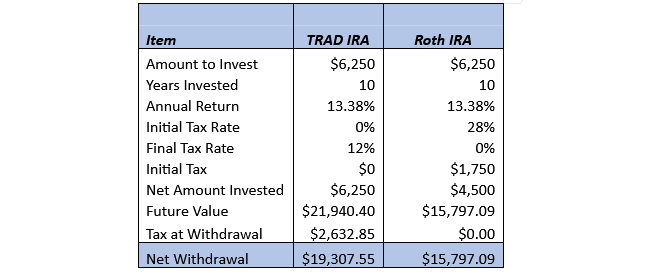 The table shows that the Traditional IRA would have been the better choice, producing about $3,500 more in available funds, or about 22% more. This demonstrates that the primary driver in choosing between a Roth and a traditional qualified account is a consideration of the tax rates at the time of contribution and at the time of distribution. There have been a number of changes to the tax code in the last decade that have contributed to the result, but I certainly didn’t predict any of them. If you guess wrong, you pay the price in a higher tax bill. In the example above, the extra $1,750 invested in the traditional account produced an additional $6,143.31 in earnings. The lower tax rate at the distribution of the traditional IRA results in the $3,500 in extra funds. Even though the Roth IRA had tax free earnings growth, the initial larger tax rate overcame that advantage, when compared to the traditional IRA. Because of my pension and my wife’s social security benefit, 85% of her social security benefit is taxable income, so that is not a consideration in our tax calculation. I used Dinkytown’s 1040 Calculator to run a series of estimates of our 2026 tax return to assess if we want to execute a Roth Conversion this year. We are still 4 years from taking RMDs, and I will start my Social Security in a year when I turn 70. My current thinking is a conversion of about $40,000 will keep us in the 12% bracket. There would also be a small NJ state tax impact. My simple analysis reinforces what I’ve been taught. Roth contributions make the most sense when you think your current tax bracket is lower than when you expect to withdrawal the funds. There are secondary considerations, like no tax diversification, no RMDs, and uncertainty about future tax rates. If you intend to pass the funds to heirs, it might make sense to perform Roth conversions today at the 22% tax bracket if you intend to pass these accounts to heirs who may be in their peak earnings years. Not sure? I believe I recall several HumbleDollar contributors write something about splitting the difference?
  Richard Connor is a semi-retired aerospace engineer with a keen interest in finance. He enjoys a wide variety of other interests, including chasing grandkids, space, sports, travel, winemaking and reading. Follow Rick on Twitter @RConnor609 and check out his earlier articles.
NO. 24: OUR ONLY earthly immortality will be the memories of others. We should make sure those memories are good—by spending our wealth on special times with friends and family.
NO. 86: CARRYING a mortgage into retirement can cost a heap of taxes. To cover the monthly payment, you might sell winning investments in your taxable account or tap retirement accounts, thus boosting your taxable income. That, in turn, could trigger higher Medicare premiums and taxes on your Social Security benefit. Result: You suffer a double tax hit.
HIRE OTHERS TO do chores you dislike. For each of us, time—not money—is the ultimate limited resource. Research has found that those who use their money to buy time—by, say, hiring others to clean or do yardwork for them—report greater happiness. Why? These folks feel less time stressed, while also freeing up extra hours for activities they love.
NO. 97: IT’S HARD to say “no” to our adult children if they get into financial trouble—which is why we should try to raise money-savvy kids. But how? Set a good example. Talk regularly about your own finances. Tell your kids about your lean early adult years. Involve them in family financial decisions. Encourage them to save up for larger purchases.
NO. 24: OUR ONLY earthly immortality will be the memories of others. We should make sure those memories are good—by spending our wealth on special times with friends and family.
Over the several years I have been writing and commenting on HD it has been made clear that the HD community includes many sophisticated investors and planners. People who use budgets, track expenses, do their best to investigate and then make financial decisions based on information they develop. They use various type of software programs and, of course, their own spreadsheets. They analyze risk and investment expenses. They like details. They think about the future. And,
WALMART SELLS FOOD. They sell car tires. Board games too. You can stop at any Walmart in the world and buy the same plethora of consumer goods. One roof, dozens of product areas, thousands of individual items.
This “cross-vertical” strategy has many perks to consumers like us. But it’s not without flaws. From brand dilution to in-store clutter, down to a lack of item expertise when you ask questions of employees – there are issues with “selling everything to everyone.”
There was a time when I probably did- that was many years ago when sailing around the Mediterranean in my luxury yacht was a fantasy. Once, decades ago, I actually explored the cost of renting such a yacht. Back then it was $200,000 a week, plus tips for the crew and the cost of the food you selected. I was afraid I couldn’t afford the tips- but I could bring eight friends to impress.
These days I don’t envy of the billionaires,
THE INVESTMENT WORLD is full of storytellers. And while these folks might be entertaining, they generally aren’t very helpful. There’s one category of stories, however, that I do think is useful: They’re what I might call investment fables. They’re apocryphal stories that likely aren’t real. But they’re helpful nonetheless because each carries a useful lesson. Here are some of the more popular ones.
Consumer choice. In 1999, Richard Mille and a partner launched a company to make wristwatches.
My favorite word is “aware.”
I believe that missed opportunities, stress, poor decisions of all types, just many of the things we complain about result from not being aware of what is happening around us.
Being aware means having knowledge or perception of something. It involves noticing, recognizing, or being conscious of what’s happening either around you or within you.
In essence, being aware is about being connected to what is happening, both internally and externally,
I have no desire to oversee a website where folks work out their anger issues by posting snarky political comments. But lately, that anger has been on full display, and we all know why. Love him or hate him, Donald Trump clearly elicits strong emotions.
But here’s the thing: Those strong emotions may be justified—but they’re hard to justify on financial grounds, just as they were hard to justify during the Biden presidency. Consider:
The unemployment rate was 4.1% when Biden left office,



Inflation Hedge
ArticleAdam M. Grossman | Aug 29, 2026
Traditional or Roth
ArticleRichard Connor | Aug 29, 2026
The Intentional Spendthrift
Mark Crothers | Aug 21, 2026
Americans and their credit cards
R Quinn | Aug 24, 2026
How Did You Find Paid Work After Retiring from Your Primary Career?
Jeffrey Chan | Jul 31, 2026
Bad Maths, Good Fire.
Mark Crothers | Aug 28, 2026
The Wrong-Sided Man
Dennis Friedman | May 8, 2025
This would be a great posting on a web site with the name “HaughtyDollar.”
R Quinn | Aug 28, 2026
You Heel!
Michael Flack | Aug 24, 2026
A Place At The Table
Andrew Clements | Aug 26, 2026
Blood Money
Michael Flack | Mar 28, 2026
Feeling TIPSy?
ArticleSanjib Saha | Aug 22, 2026