You can dissuade folks from making foolish investments. But once they buy, they’re bought in—and it’s awfully tough to get them to change.
AFTER ENRON'S COLLAPSE in 2001, there were numerous articles about employees who had most of their money in the company’s stock and how they’d lost it all. Taking that message to heart, I’ve endeavored to keep our holdings of my company’s stock below 10% of our net worth. I must confess, however, that in good times it’s crept up to 15%—and in bad times it’s fallen to zero.
I can’t claim any particular insights or novel thoughts on how to manage company stock. I’m willing to share what I’ve done, however, and let you decide how to handle your situation.
My company stock came from three main sources: the employee stock purchase plan, the match on my 401(k) contributions, and the stock options or restricted stock awards received as part of my annual compensation. As you’ll see, these three stock programs represent the good, the bad and the ugly of my investing career.
The employee stock purchase plan was the good. In our plan, we were allowed to divert up to 10% of our salary to company stock. The best part was that we could buy the stock at a 15% discount to current market prices.
Early in my career, there was a machine operator who was retiring. The word in the factory was that he was wealthy. He had been stashing 10% of his pay in company stock for the past 45 years. He had never touched the shares. I’m sure his retirement was much more comfortable than that of most machine operators.
I also spent my first five years at the company not touching the stock. We then sold it to make the downpayment on our house. Shortly thereafter, I decided I needed to rethink how to handle the stock purchase plan so I wasn’t overly reliant on the company.
For about 20 years, I was able to sell the stock after holding it for only a month. I would purchase the stock one month at a 15% discount and sell it the next month. I always made money. Depending on the market, sometimes I made more than 15% and sometimes less.
Some coworkers would scold me, telling me that I should hold the stock for a year to qualify for the lower long-term capital gains rate on my profits. My reply was that—depending on how you do the math—I was making an annualized return of as much as 603%, so I was happy to pay the ordinary income-tax rate. (For math nerds, a 15% discount is equal to an immediate 17.6% monthly gain on the purchase price. Compounded over 12 months, that comes to 603%.)
Some would look at me blankly, saying that I was only making 15%. When I couldn’t convince them that I was making far, far more than that on an annualized basis, I’d offer to lend them all the money they wanted at 5% a month. None of them took me up on the offer.
Eventually, to encourage long-term investing, the company changed the rules and required a year-long holding period before selling. At the end of the year, rather than selling, we’d donate the shares we’d purchased to charity, thereby avoiding any taxes on the gains.
For a while, the company paid its 401(k) matching contribution in company stock, which meant we had an ever-increasing exposure to this single stock. Shortly after Enron blew up, my employer stopped paying the match in company stock, while also allowing us to sell whatever company stock we had in our 401(k) and invest the money in one of the plan’s mutual funds.
I promptly traded half my company stock for shares in a broad-based mutual fund. Why only half? I’d heard about the tax advantages of net unrealized appreciation of company stock held within a 401(k). Executed correctly, when you sell, you pay income taxes on the original cost basis of the stock but the lower long-term rate on any gains. I thought that in 20 years, when I retired, this would be a good deal.
Fast forward 20 years. I was planning on withdrawing my company stock from the 401(k). Remember the good, the bad and the ugly? This is where we get to the bad. First, the stock had fallen in price, dramatically reducing both its value and the strategy’s tax advantages.
[xyz-ihs snippet="Mobile-Subscribe"]Second, I read research by financial planner Michael Kitces suggesting that if you plan to own company stock for the long term, you’d be better off buying it outside the 401(k) to obtain the more favorable long-term capital gain rate on the whole investment and not just on a portion of it. I decided to sell all my shares and diversify using mutual funds in my 401(k). In hindsight, I realize I should have done this much earlier.
What about the ugly? That’s been the performance of my company stock options. Part of my compensation was “at risk” compensation. We were able to take this as either restricted stock units, which is a grant of shares at some future time, or as stock options, which would have value only if the shares achieved a specified price in the future. According to my employer, the value of either award was calculated to be the same when they vested in three years.
Every year, when it came time to choose how to receive this compensation, there would be lots of discussion about which was the better choice. When asked my opinion, I always said that what I was planning to do wasn’t appropriate for all people, but I’d be taking all my shares in stock options.
I had 20 years of data going back to 1978 showing that, if you held the stock options until they expired in 10 years, they performed significantly better than the restricted stock units. I planned to use my stock options as income during the 10 years following my retirement at age 60, and then claim Social Security at age 70.
I’m retired now and my remaining stock options are worth exactly zero dollars. Some may be worth money in the future if the company’s shares rise, but the hoped-for income stream from the stock options has vanished. Fortunately, I saved and invested well enough so I won’t have to claim Social Security before 70.
Although my stock option decision didn’t play out as planned, the poker player Annie Duke cautions people to not confuse the results with the decision-making process. In other words, you can be right and still lose money. I believe that my process was sound. I knew there was a potential for the options to be worth nothing and so, while it’s disappointing, it’s a financial setback I was prepared for.
While there are lots of valid ways to treat company stock, my advice would be to limit the value of your company stock to 10% or less of your total portfolio. As I’ve learned, company stock is a concentrated investment—and you may not be rewarded for the extra risk you run.
Kenyon Sayler is a retired mechanical engineer. He and his wife Lisa are extraordinarily proud of their two adult sons. He enjoys walking his dog, traveling, reading and gardening. Kenyon's brother Larry also writes for HumbleDollar. Check our Kenyon's earlier articles. [xyz-ihs snippet="Donate"]WHEN RESTRICTIONS ON travel eased this year, I visited Kolkata, India, where I grew up and my mother still lives. The airline ticket and other travel costs were almost 75% higher than my last visit four years ago.
This year, I’ve grown used to price shocks at every turn, from groceries to gas, so the steep ticket price didn’t shock me. What did surprise me was my feeling of affluence once I arrived.
Traveling to a low-cost country as a tourist doesn’t necessarily feel like a bargain because most items still have an international price tag. But living like a local is another matter. Everything seems dirt cheap to folks from high-income countries. Curious to know how far my U.S.-earned dollars went during my stay in India? Consider:
A dime would get me a freshly made hot tea from a roadside tea stall, served in a disposable earthen cup. For a nickel more, most sellers would upgrade it to a masala chai—milk tea flavored with ginger, cardamon and other aromatic spices.
A quarter paid for the return bus ticket to my aunt’s place four miles away. What else could I buy for a quarter? How about a recently picked large guava to savor with rock salt, or a bag of fresh flowers that my mother needed for her morning offerings to the gods?
A half-dollar would buy a hearty Bengali breakfast dish from an outdoor eatery, if you didn’t mind waiting while the cook prepares it right in front of you. The food would typically be served on a Sal leaf plate, to be trashed afterward in a designated bin.
A dollar for a man’s haircut might sound like a promotional offer, but that’s the regular price in the neighborhood salon—and it wasn’t due to the thinning hair of its regular customers. The small shop not only had the needed hygiene standards, leather seats and air-conditioning, but also offered nice add-ons, like a 30-minute head and shoulder massage for one dollar more.
Two dollars was the cost of my cab ride from the Kolkata airport to our house five miles away. As soon as I walked out of the arrival gate, a few touts approached me to offer a no-wait, luxurious ride. I declined and waited in the queue for pre-paid cabs. Fifteen minutes later, I got a cab assigned to me, helped the driver to load my bags and was on my way.
Five dollars covered the electrician’s labor for two visits to our house to take care of a few things for my mother. The work didn’t take long but, as a courtesy to my mother, he also bought the necessary fixtures from our neighborhood electrical store.
Ten dollars may not seem like a lot, but it was enough for a trained masseuse to come over and help me with my sore calf muscles and feet. The massage lasted about an hour, not including a brief break for tea and light snacks that my mother made for him.
[xyz-ihs snippet="Holiday-Donate"]Fifteen dollars was the cost to take my mother for a sumptuous lunch at a trendy restaurant on Park Street, the Fifth Avenue of Kolkata. The fresh green coconut water added another dollar to the restaurant bill. The experience and service were well worth the hefty tip we left.
Twenty dollars got me an all-day ride in a private, chauffeur-driven compact car. We started in the morning to visit a few places within a 25-mile radius and returned in the evening. I could’ve used a ride-hailing service instead, but the neighborhood operator seemed more friendly and convenient.
Twenty-five dollars covered both the labor and materials for a long-overdue plumbing overhaul of the main bathroom. The plumber replaced the leaking pipes, ran a new water connection to improve the flow and installed a new showerhead. He took two days to complete the work, and it was immaculate.
One hundred dollars connected our home with high-speed broadband internet for a year. I tested to check if the connection lived up to the advertised speed of 100 Mbps. It outperformed.
One thousand dollars covered the cost of new Bosch appliances I bought for my mother and sister-in-law. These included an energy-efficient refrigerator, an automatic front-loading washing machine and a high-powered kitchen chimney. The cost, which included delivery and installation, was lower than I expected thanks to the seasonal discount for the Diwali festivals.
My feeling of affluence was shattered as soon as I was on my way back to the U.S. A cup of tea purchased past the security checkpoints at Kolkata airport cost $3. Thirty hours and 9,000 miles later, I was home, catching up with my wife after being away for a month. That was a moment worth $1 million.
Sanjib Saha is a software engineer by profession, but he's now transitioning to early retirement. Self-taught in investments, he passed the Series 65 licensing exam as a non-industry candidate. Sanjib is passionate about raising financial literacy and enjoys helping others with their finances. Check out his earlier articles. [xyz-ihs snippet="Donate"]I WAS SCROLLING through social media recently and saw somebody dismiss retirement accounts as “paper wealth.” The argument was familiar: Your money is locked away and you’re waiting for permission to access it.

There’s a grain of truth here. Retirement accounts do come with rules. But much of the discussion online ignores how flexible these accounts actually are. More important, it ignores the enormous tax advantages.
Most people today will likely live well beyond age 59½. Many will spend two or three decades in retirement. Even if somebody retires early, they’ll still need assets later in life.
That’s why ignoring retirement accounts at age 30 often isn’t wise. You could end up giving away 30 or 40 years of tax-advantaged compounding.
It also isn’t an all-or-nothing decision. We can use taxable brokerage accounts, Roth IRAs and 401(k)s together. Each account serves a different purpose.
Retirement accounts also provide rebalancing flexibility that taxable accounts don’t.
Inside a Traditional or Roth IRA, investors can rebalance portfolios without triggering capital gains taxes. Somebody who wants less stock market exposure can freely sell shares and buy bonds, Treasurys or other funds without generating an immediate tax bill. That matters over long periods of time.
The other misconception is that retirement accounts are completely inaccessible until age 59½.
Let's talk about Rule 72(t), also called Substantially Equal Periodic Payments, or SEPP. This IRS rule allows penalty-free withdrawals before age 59½ if specific requirements are followed.
Using online 72(t) calculators, a $500,000 retirement account could potentially generate annual withdrawals of roughly $30,000 while avoiding the normal 10% early-withdrawal penalty:

The payments must continue for a required period and the IRS rules are strict. Still, the broader point remains: There are legal ways to access retirement funds earlier than many people realize.
The Rule of 55 is another example.
If you leave your employer during or after the year you turn 55, you can often withdraw money from that employer’s 401(k) without the normal 10% penalty. Again, the money is not completely locked away until 60.
Roth IRAs may also be flexible. Contributions can be withdrawn anytime tax- and penalty-free because taxes were already paid before the money went into the account.
That doesn’t mean people should tap retirement accounts early. But accessibility is very different from impossibility.
Roth IRAs also happen to be among the most powerful wealth building tools available.
Qualified withdrawals are tax-free. Dividends compound without yearly tax bills. Investors can buy and sell investments inside the account without triggering taxable events.
You may remember a famous example about Peter Thiel. According to reporting by ProPublica, Thiel reportedly grew a Roth IRA from $2,000 to more than $5 billion between 1999 and now. He turns 59½ in 2027, meaning those withdrawals could potentially be tax-free. Imagine if he had decided to skip retirement accounts because he wanted to “live now.”
Employer matches are another point often ignored online. Skipping a 401(k) match can be one of the costliest financial mistakes people make.
Suppose an employer offers a dollar-for-dollar match on the first 3% of salary contributed to a 401(k). Before the investments even grow, that’s effectively an immediate 100% return.
Very few opportunities offer that kind of risk-adjusted benefit.
In fact, somebody could theoretically contribute, collect the employer match, later withdraw the money, pay ordinary income taxes plus the 10% penalty, and still potentially come out ahead versus investing only through a taxable brokerage account with no match.
The tax advantages extend beyond employer matches.
Inside retirement accounts:
Compare that with a taxable brokerage account, where dividends may create yearly tax bills and selling appreciated shares can trigger capital gains taxes.
Retirement accounts can also create opportunities for tax arbitrage.
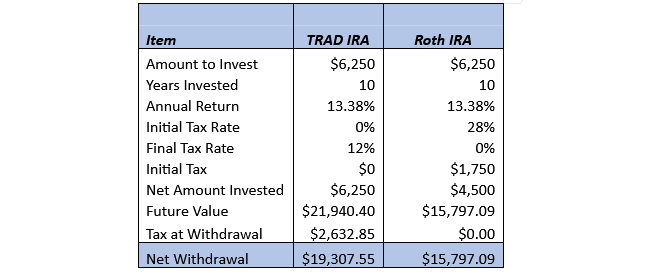
Somebody contributing while in the 22% or 24% marginal federal tax bracket today might eventually withdraw money while in the 10% or 12% bracket during retirement.
State taxes can widen the advantage even more. Some states provide tax deductions on retirement contributions while later taxing retirement withdrawals lightly or not at all.
Early retirees often use Roth conversion ladders as well.
The process generally works like this:
Like Rule 72(t), there are strict rules involved. But these strategies exist because retirement accounts were never designed to be prison cells.
The larger point is that retirement planning should involve multiple tools working together. Taxable brokerage accounts provide flexibility. Roth IRAs provide tax-free growth. Traditional retirement accounts can reduce taxes during high-earning years.
None of these accounts are perfect by themselves. Together, however, they can create an extremely efficient system for building long-term wealth.
That’s why describing retirement accounts as “paper wealth” misses the bigger picture.
NO. 61: WHEN in doubt, we should invest long-term investment money in a target-date index fund. Most of us will struggle to design and maintain a portfolio that performs any better.
AUTOMATE YOUR bill paying. That way, you’ll avoid late payments—crucial to maintaining a good credit score. The downside: You need to be vigilant about keeping enough in your bank account, so you don’t trigger fees for overdrafts or insufficient funds. This is a particular concern with credit card bills, which can vary so much from one month to the next.
NO. 69: RECEIVING a pension or Social Security benefits is akin to owning bonds. Most pensions are like a fixed-interest bond, while Social Security is like an inflation-indexed bond. One implication: If you’ll receive a hefty portion of your retirement income from these two sources, you may have the leeway to invest more heavily in the stock market.
MARKET EFFICIENCY. As news breaks that effect the economy and individual companies, investors immediately buy and sell stocks in response, so share prices reflect all publicly available information. Because the market is so efficient, it’s all but impossible for investors to beat the market averages over the long haul, especially after figuring in their own investment costs.
NO. 61: WHEN in doubt, we should invest long-term investment money in a target-date index fund. Most of us will struggle to design and maintain a portfolio that performs any better.
Here I sit on my deck, the blue sky is cloudless. It is 74 degrees, no wind and quiet except for the birds making their views known. My view of anything beyond 50 feet is blocked by thickly leaved trees.
Between writing, I read commentary about tariffs, trade, economies on Project-Syndicate, a daily updated compilation of articles from scores of international writers. I’m also reading about the Salem witch trials and Ben Franklin’s rise to fame and testimony before Parliament about taxing the colonies –
Throughout my working years, one thing that disturbed me greatly was the lack of concern even disregard shown by many workers for a spouse, especially a surviving spouse and nearly always a woman.
I remember the “good old days” when the husband’s earnings were his money, his pension was his pension. I remember when workers hid their overtime pay from the wife and when they elected a single life annuity pension because only they earned it,
I say it does, but that does not stop it from being attacked. The words Ponzi Scheme are being thrown about. The fact it is underfunded is being used as a argument that it doesn’t work. Some in government are calling for it to be replaced with private accounts. I read one official say there is plenty of money to pay all the benefits to those now collecting, but we can’t continue. Well, that’s not true on either point.
I’ve been working to educate myself on the US pension system, particularly the retirement decumulation landscape. It’s a challenging endeavor, but through diligent research, I’m slowly grasping the essentials. From an outsider’s viewpoint, the complexity that various US administrations have introduced into this system is striking. As a UK citizen, I find several aspects particularly perplexing:
The Sheer Number and Variety of Retirement Accounts: In the UK, it’s largely about defined contribution and defined benefit pensions,
This morning, while sipping coffee in my sunroom, a simple thought occurred – one of those rare insights, I don’t have them often! It struck me that since retiring, my morning brew has become more enjoyable. After mulling it over, I pinpointed the reason: time. More specifically, the luxury of extra time to truly savour and embrace the entire coffee experience.
This revelation isn’t confined to my coffee cup. It’s weaving its way into other aspects of my life too.
I stumbled upon this site about 18 months ago and have been reading ever since.
When I heard about Jonathan’s diagnosis, it really got me thinking about how I could contribute. The thing is, I’m based in the UK, and I was a bit hesitant at first because I know Humble Dollar primarily focuses on US personal finance – especially with all the ins and outs of US pension planning.
But I decided to post a few essays on some more general financial topics,
TEST
testmay18 | May 20, 2026
The Company You Keep
ArticleKenyon Sayler | Jul 18, 2023
AFTER ENRON'S COLLAPSE in 2001, there were numerous articles about employees who had most of their money in the company’s stock and how they’d lost it all. Taking that message to heart, I’ve endeavored to keep our holdings of my company’s stock below 10% of our net worth. I must confess, however, that in good times it’s crept up to 15%—and in bad times it’s fallen to zero.
I can’t claim any particular insights or novel thoughts on how to manage company stock. I’m willing to share what I’ve done, however, and let you decide how to handle your situation.
My company stock came from three main sources: the employee stock purchase plan, the match on my 401(k) contributions, and the stock options or restricted stock awards received as part of my annual compensation. As you’ll see, these three stock programs represent the good, the bad and the ugly of my investing career.
The employee stock purchase plan was the good. In our plan, we were allowed to divert up to 10% of our salary to company stock. The best part was that we could buy the stock at a 15% discount to current market prices.
Early in my career, there was a machine operator who was retiring. The word in the factory was that he was wealthy. He had been stashing 10% of his pay in company stock for the past 45 years. He had never touched the shares. I’m sure his retirement was much more comfortable than that of most machine operators.
I also spent my first five years at the company not touching the stock. We then sold it to make the downpayment on our house. Shortly thereafter, I decided I needed to rethink how to handle the stock purchase plan so I wasn’t overly reliant on the company.
For about 20 years, I was able to sell the stock after holding it for only a month. I would purchase the stock one month at a 15% discount and sell it the next month. I always made money. Depending on the market, sometimes I made more than 15% and sometimes less.
Some coworkers would scold me, telling me that I should hold the stock for a year to qualify for the lower long-term capital gains rate on my profits. My reply was that—depending on how you do the math—I was making an annualized return of as much as 603%, so I was happy to pay the ordinary income-tax rate. (For math nerds, a 15% discount is equal to an immediate 17.6% monthly gain on the purchase price. Compounded over 12 months, that comes to 603%.)
Some would look at me blankly, saying that I was only making 15%. When I couldn’t convince them that I was making far, far more than that on an annualized basis, I’d offer to lend them all the money they wanted at 5% a month. None of them took me up on the offer.
Eventually, to encourage long-term investing, the company changed the rules and required a year-long holding period before selling. At the end of the year, rather than selling, we’d donate the shares we’d purchased to charity, thereby avoiding any taxes on the gains.
For a while, the company paid its 401(k) matching contribution in company stock, which meant we had an ever-increasing exposure to this single stock. Shortly after Enron blew up, my employer stopped paying the match in company stock, while also allowing us to sell whatever company stock we had in our 401(k) and invest the money in one of the plan’s mutual funds.
I promptly traded half my company stock for shares in a broad-based mutual fund. Why only half? I’d heard about the tax advantages of net unrealized appreciation of company stock held within a 401(k). Executed correctly, when you sell, you pay income taxes on the original cost basis of the stock but the lower long-term rate on any gains. I thought that in 20 years, when I retired, this would be a good deal.
Fast forward 20 years. I was planning on withdrawing my company stock from the 401(k). Remember the good, the bad and the ugly? This is where we get to the bad. First, the stock had fallen in price, dramatically reducing both its value and the strategy’s tax advantages.
[xyz-ihs snippet="Mobile-Subscribe"]Second, I read research by financial planner Michael Kitces suggesting that if you plan to own company stock for the long term, you’d be better off buying it outside the 401(k) to obtain the more favorable long-term capital gain rate on the whole investment and not just on a portion of it. I decided to sell all my shares and diversify using mutual funds in my 401(k). In hindsight, I realize I should have done this much earlier.
What about the ugly? That’s been the performance of my company stock options. Part of my compensation was “at risk” compensation. We were able to take this as either restricted stock units, which is a grant of shares at some future time, or as stock options, which would have value only if the shares achieved a specified price in the future. According to my employer, the value of either award was calculated to be the same when they vested in three years.
Every year, when it came time to choose how to receive this compensation, there would be lots of discussion about which was the better choice. When asked my opinion, I always said that what I was planning to do wasn’t appropriate for all people, but I’d be taking all my shares in stock options.
I had 20 years of data going back to 1978 showing that, if you held the stock options until they expired in 10 years, they performed significantly better than the restricted stock units. I planned to use my stock options as income during the 10 years following my retirement at age 60, and then claim Social Security at age 70.
I’m retired now and my remaining stock options are worth exactly zero dollars. Some may be worth money in the future if the company’s shares rise, but the hoped-for income stream from the stock options has vanished. Fortunately, I saved and invested well enough so I won’t have to claim Social Security before 70.
Although my stock option decision didn’t play out as planned, the poker player Annie Duke cautions people to not confuse the results with the decision-making process. In other words, you can be right and still lose money. I believe that my process was sound. I knew there was a potential for the options to be worth nothing and so, while it’s disappointing, it’s a financial setback I was prepared for.
While there are lots of valid ways to treat company stock, my advice would be to limit the value of your company stock to 10% or less of your total portfolio. As I’ve learned, company stock is a concentrated investment—and you may not be rewarded for the extra risk you run.
Relative Affluence
ArticleSanjib Saha | Dec 6, 2022
WHEN RESTRICTIONS ON travel eased this year, I visited Kolkata, India, where I grew up and my mother still lives. The airline ticket and other travel costs were almost 75% higher than my last visit four years ago.
This year, I’ve grown used to price shocks at every turn, from groceries to gas, so the steep ticket price didn’t shock me. What did surprise me was my feeling of affluence once I arrived.
Traveling to a low-cost country as a tourist doesn’t necessarily feel like a bargain because most items still have an international price tag. But living like a local is another matter. Everything seems dirt cheap to folks from high-income countries. Curious to know how far my U.S.-earned dollars went during my stay in India? Consider:
A dime would get me a freshly made hot tea from a roadside tea stall, served in a disposable earthen cup. For a nickel more, most sellers would upgrade it to a masala chai—milk tea flavored with ginger, cardamon and other aromatic spices.
A quarter paid for the return bus ticket to my aunt’s place four miles away. What else could I buy for a quarter? How about a recently picked large guava to savor with rock salt, or a bag of fresh flowers that my mother needed for her morning offerings to the gods?
A half-dollar would buy a hearty Bengali breakfast dish from an outdoor eatery, if you didn’t mind waiting while the cook prepares it right in front of you. The food would typically be served on a Sal leaf plate, to be trashed afterward in a designated bin.
A dollar for a man’s haircut might sound like a promotional offer, but that’s the regular price in the neighborhood salon—and it wasn’t due to the thinning hair of its regular customers. The small shop not only had the needed hygiene standards, leather seats and air-conditioning, but also offered nice add-ons, like a 30-minute head and shoulder massage for one dollar more.
Two dollars was the cost of my cab ride from the Kolkata airport to our house five miles away. As soon as I walked out of the arrival gate, a few touts approached me to offer a no-wait, luxurious ride. I declined and waited in the queue for pre-paid cabs. Fifteen minutes later, I got a cab assigned to me, helped the driver to load my bags and was on my way.
Five dollars covered the electrician’s labor for two visits to our house to take care of a few things for my mother. The work didn’t take long but, as a courtesy to my mother, he also bought the necessary fixtures from our neighborhood electrical store.
Ten dollars may not seem like a lot, but it was enough for a trained masseuse to come over and help me with my sore calf muscles and feet. The massage lasted about an hour, not including a brief break for tea and light snacks that my mother made for him.
[xyz-ihs snippet="Holiday-Donate"]Fifteen dollars was the cost to take my mother for a sumptuous lunch at a trendy restaurant on Park Street, the Fifth Avenue of Kolkata. The fresh green coconut water added another dollar to the restaurant bill. The experience and service were well worth the hefty tip we left.
Twenty dollars got me an all-day ride in a private, chauffeur-driven compact car. We started in the morning to visit a few places within a 25-mile radius and returned in the evening. I could’ve used a ride-hailing service instead, but the neighborhood operator seemed more friendly and convenient.
Twenty-five dollars covered both the labor and materials for a long-overdue plumbing overhaul of the main bathroom. The plumber replaced the leaking pipes, ran a new water connection to improve the flow and installed a new showerhead. He took two days to complete the work, and it was immaculate.
One hundred dollars connected our home with high-speed broadband internet for a year. I tested to check if the connection lived up to the advertised speed of 100 Mbps. It outperformed.
One thousand dollars covered the cost of new Bosch appliances I bought for my mother and sister-in-law. These included an energy-efficient refrigerator, an automatic front-loading washing machine and a high-powered kitchen chimney. The cost, which included delivery and installation, was lower than I expected thanks to the seasonal discount for the Diwali festivals.
My feeling of affluence was shattered as soon as I was on my way back to the U.S. A cup of tea purchased past the security checkpoints at Kolkata airport cost $3. Thirty hours and 9,000 miles later, I was home, catching up with my wife after being away for a month. That was a moment worth $1 million.
The Art of Spending Money
Jeff Peck | May 17, 2026
Should Retirees Get a Temporary Flat Tax Window on IRA and 401(k) Withdrawals?
Jeff Peck | May 18, 2026
Direct Indexing Anyone?
ostrichtacossaturn7593 | May 10, 2026
Writing a Book in Retirement: The Good, the Hard, and the Surprisingly Meaningful
mllange | May 13, 2026
First Job, Lasting Impact
D.J. | May 14, 2026
Retirement Accounts
ArticleBogdan Sheremeta | May 16, 2026
I WAS SCROLLING through social media recently and saw somebody dismiss retirement accounts as “paper wealth.” The argument was familiar: Your money is locked away and you’re waiting for permission to access it.
There’s a grain of truth here. Retirement accounts do come with rules. But much of the discussion online ignores how flexible these accounts actually are. More important, it ignores the enormous tax advantages.
Most people today will likely live well beyond age 59½. Many will spend two or three decades in retirement. Even if somebody retires early, they’ll still need assets later in life.
That’s why ignoring retirement accounts at age 30 often isn’t wise. You could end up giving away 30 or 40 years of tax-advantaged compounding.
It also isn’t an all-or-nothing decision. We can use taxable brokerage accounts, Roth IRAs and 401(k)s together. Each account serves a different purpose.
Retirement accounts also provide rebalancing flexibility that taxable accounts don’t.
Inside a Traditional or Roth IRA, investors can rebalance portfolios without triggering capital gains taxes. Somebody who wants less stock market exposure can freely sell shares and buy bonds, Treasurys or other funds without generating an immediate tax bill. That matters over long periods of time.
The other misconception is that retirement accounts are completely inaccessible until age 59½.
Let's talk about Rule 72(t), also called Substantially Equal Periodic Payments, or SEPP. This IRS rule allows penalty-free withdrawals before age 59½ if specific requirements are followed.
Using online 72(t) calculators, a $500,000 retirement account could potentially generate annual withdrawals of roughly $30,000 while avoiding the normal 10% early-withdrawal penalty:
The payments must continue for a required period and the IRS rules are strict. Still, the broader point remains: There are legal ways to access retirement funds earlier than many people realize.
The Rule of 55 is another example.
If you leave your employer during or after the year you turn 55, you can often withdraw money from that employer’s 401(k) without the normal 10% penalty. Again, the money is not completely locked away until 60.
Roth IRAs may also be flexible. Contributions can be withdrawn anytime tax- and penalty-free because taxes were already paid before the money went into the account.
That doesn’t mean people should tap retirement accounts early. But accessibility is very different from impossibility.
Roth IRAs also happen to be among the most powerful wealth building tools available.
Qualified withdrawals are tax-free. Dividends compound without yearly tax bills. Investors can buy and sell investments inside the account without triggering taxable events.
You may remember a famous example about Peter Thiel. According to reporting by ProPublica, Thiel reportedly grew a Roth IRA from $2,000 to more than $5 billion between 1999 and now. He turns 59½ in 2027, meaning those withdrawals could potentially be tax-free. Imagine if he had decided to skip retirement accounts because he wanted to “live now.”
Employer matches are another point often ignored online. Skipping a 401(k) match can be one of the costliest financial mistakes people make.
Suppose an employer offers a dollar-for-dollar match on the first 3% of salary contributed to a 401(k). Before the investments even grow, that’s effectively an immediate 100% return.
Very few opportunities offer that kind of risk-adjusted benefit.
In fact, somebody could theoretically contribute, collect the employer match, later withdraw the money, pay ordinary income taxes plus the 10% penalty, and still potentially come out ahead versus investing only through a taxable brokerage account with no match.
The tax advantages extend beyond employer matches.
Inside retirement accounts:
Compare that with a taxable brokerage account, where dividends may create yearly tax bills and selling appreciated shares can trigger capital gains taxes.
Retirement accounts can also create opportunities for tax arbitrage.
Somebody contributing while in the 22% or 24% marginal federal tax bracket today might eventually withdraw money while in the 10% or 12% bracket during retirement.
State taxes can widen the advantage even more. Some states provide tax deductions on retirement contributions while later taxing retirement withdrawals lightly or not at all.
Early retirees often use Roth conversion ladders as well.
The process generally works like this:
Like Rule 72(t), there are strict rules involved. But these strategies exist because retirement accounts were never designed to be prison cells.
The larger point is that retirement planning should involve multiple tools working together. Taxable brokerage accounts provide flexibility. Roth IRAs provide tax-free growth. Traditional retirement accounts can reduce taxes during high-earning years.
None of these accounts are perfect by themselves. Together, however, they can create an extremely efficient system for building long-term wealth.
That’s why describing retirement accounts as “paper wealth” misses the bigger picture.
Resilient Investing
ArticleAdam M. Grossman | May 16, 2026
Don’t Push It
ArticleJonathan Clements | Apr 11, 2025
There is no such thing as a tax loophole, but here they are anyway
R Quinn | May 17, 2026
- Tax planning opportunities (whether you call them a loophole is semantic) when there is a difference in tax rates across time periods (IRA vs taxable account) / types of income (income, dividends, gains, etc.) / jurisdiction (MA vs. FL) / object of tax (married vs. single) / other factors. Within each cut, effective tax planning seeks to move money from a category with a higher tax rate to one with a lower tax rate.
- We create a mess (and opportunities for tax planning by creating the above wedges) when we comingle social / economic policy with tax policy. A progressive tax rate is a simple example ... it implicitly assumes that richer people ought to pay more. Likewise, why seek to favor investments via a lower rate on LT capital gains rate? Why promote marriage with a higher slab for married filing jointly versus two people living together and filing as individuals? In my view, every attempt to alter behavior via tax policy has unintended consequences which has created the "tax planning" industry.
Having said this, I think divorcing the social / economic and tax policy is not that easy or straightforward. So, I think we are stuck in this mess for the long haul. And, as a rational person, it makes sense to tax plan as much as possible."