FREE NEWSLETTER

A RECENT post by achnk53 about the impact of a spouse’s death on the survivor’s taxes piqued my interest. The post referenced an interesting Kiplinger article about the “Widow’s Penalty”, or the negative tax implications on a surviving spouse after the death of a spouse. A surviving spouse can file Married Filing Jointly (MFJ) in the year of their spouse’s death. In the full year following the spouse’s death you must file Single. There are some beneficial filing rules for surviving spouses who have dependent children, but that is beyond this post.
Nine days later John Urban published an article running the tax numbers for 3 different retiree scenarios, and using the data to provide some excellent suggestions for readers. In between these two articles I had run some similar case studies to understand the impacts.
I ran some case studies using the 2026 Dinkytown 1040 Calculator. I considered a “lower” income retired couple. The impact of one spouse passing is very dependent on the sources of income. Assume the retired couple were each receiving $36,000 in annual SS benefits. They have no other sources of income. The couple filing jointly would have no taxable income, and no tax for 2026. Had the husband died in 2025, the surviving widow would have seen her income reduced to $36,000. If she needed the lost income, and found a job that paid $36,000, her income would match the original $72,000. But $21,500 of her SS benefit would be taxable, her taxable income would be $33,350, and her annual tax bill would be $3,757. The table below shows the details of this analysis:
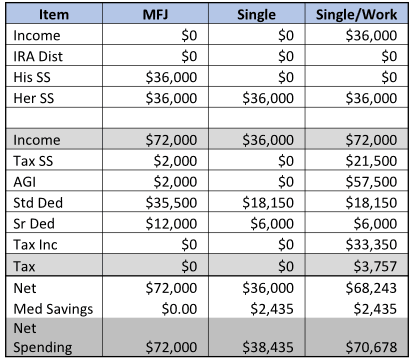
After accounting for the reduction in Medicare related spending, she has similar spending power. But she had to go back to work to achieve that. This, and the previous examples, reinforce the importance of understanding a couple’s financial details before and after the passing of a spouse. Income will likely be reduced, but expenses may also be reduced. Lower income retirees who depend primarily on both partners SS benefits may see the biggest impact.
I also ran a comparison of our tax return for 2026, for both MFJ and if my wife filed single. I assumed our income consisted of my pension, my wife’s SS benefit, and my SS benefit had I claimed it on January 1, 2026. When I die my wife will receive 75% of my pension, and my higher SS benefit. The results were not surprising.
I then ran an additional scenario with the same assumptions, but also assuming we were 4 years older and would both have to take initial RMDs in 2026. This scenario reflects one of the concerns frequently expressed when discussing this topic – what happens when the surviving spouse is responsible for reporting the income from both RMDs on her Single tax return. The results changed to reflect the scenario.
These results are a simplified look at our finances today. My pension and my wife’s SS benefit cover our non-discretionary, and a decent portion of our discretionary, expenses. The wild card is travel – how much we spend in any year is our choice and may require additional income. I’m about 11 months from claiming my SS benefit, at which point virtually all of our expenses will be covered in a fairly tax-efficient way. RMDs are still 4 years away.
This was a good exercise to get a feel of how my demise would impact my wife’s finances. It would have some financial impacts, but I believe our plan can handle them. I’m considering running some more detailed projections varying the age at death to assess the impacts, but a quick look made me reasonably confident our retirement savings will be adequate, even considering long term care. I will also continue to look at Roth conversions each year.
 Richard Connor is a semi-retired aerospace engineer with a keen interest in finance. He enjoys a wide variety of other interests, including chasing grandkids, space, sports, travel, winemaking and reading. Follow Rick on Twitter @RConnor609 and check out his earlier articles.

Regardless of individual circumstances, Rick’s article is a good reminder that the more financially savvy partner should run the numbers, devise a plan and, most importantly, share the plan with the partner verbally and in writing. I am forever grateful that Doug did this for me. After his death, when people asked me (somewhat intrusively but out of concern) “Will you be able to keep your house?”, I always knew that the answer was “Yes.” Not everyone is so fortunate.
Good exercise to run the numbers, RC. But these calculations have so many variables and depend so specifically on the finances of each family. The SSA payments (start date, amounts) are likely standardized for most HD readers. But issues like pensions (amount, survivor share), RMDs (size of investment accounts), and withdrawals from taxable accounts (how much in embedded LTCGs) must vary wildly.
Strong argument here, too, for holding substantial Roth balances to finance the survivor’s first few years after the partner’s death. Tax-free withdrawals to pay for expenses can allow for planning / visibility into how future years will go and to prepare for bigger tax bills.
Thanks Mike. I agree that the details matter greatly. That’s why I wanted to run our specific situation to get a feel for the impact.
Free Newsletter
Arrives weekly.