
THE CHOICE BETWEEN a traditional retirement account or a Roth is a frequent topic on HumbleDollar. The choice is generally framed as a choice between paying taxes up front (a Roth), or deferring taxes until withdrawal (traditional). I thought it would be interesting to evaluate a real-life example of how this choice might work out.
In December of 2016 my wife and I had an opportunity to each open a Roth IRA. My wife took a partial sabbatical that year, and that, combined with maxing out our 401k accounts, gave us a chance to each open a $4,500 Roth IRA. The maximum allowable contribution that year was $6,500 for those 50 and over. Up until then we had assumed that our marginal tax bracket would likely be lower in retirement, and focused on contributing to our employer’s traditional 401k plans. Despite that, we decided to move forward with opening a Roth IRA. I thought it would give us some tax diversity, and the opportunity to do Roth conversions when, and if, it made sense in the future.
In December of 2016 we opened Roth IRAs at Vanguard and invested the $4,500 in their S&P 500 Index Fund. Those initial funds have been invested for almost 10 years. Over that decade we have added some additional funds, and have done a few conversions. I recently did a quick analysis to see how my Roth experience would have compared to investing in a traditional IRA.
In 2016, our marginal tax bracket was 28%. To contribute the $4,500 required $6,250 of pre-tax income. Due to some financial engineering over the last year, including selling our second home in late 2025, I expect our 2026 marginal tax bracket to stay within the 12% bracket. I’ve been looking at this closely because I’m considering doing a Roth conversion later this year. The table below shows the comparison between the Roth performance, and what a traditional IRA would have produced. The annual rate of return was determined using Nick Maggiulli’s S&P 500 Historical Return Calculator.
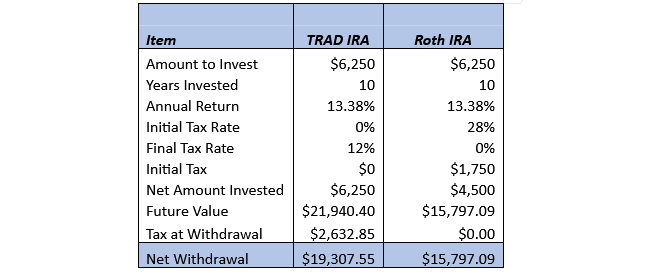
The table shows that the Traditional IRA would have been the better choice, producing about $3,500 more in available funds, or about 22% more. This demonstrates that the primary driver in choosing between a Roth and a traditional qualified account is a consideration of the tax rates at the time of contribution and at the time of distribution. There have been a number of changes to the tax code in the last decade that have contributed to the result, but I certainly didn’t predict any of them.
If you guess wrong, you pay the price in a higher tax bill. In the example above, the extra $1,750 invested in the traditional account produced an additional $6,143.31 in earnings. The lower tax rate at the distribution of the traditional IRA results in the $3,500 in extra funds. Even though the Roth IRA had tax free earnings growth, the initial larger tax rate overcame that advantage, when compared to the traditional IRA.
Because of my pension and my wife’s social security benefit, 85% of her social security benefit is taxable income, so that is not a consideration in our tax calculation. I used Dinkytown’s 1040 Calculator to run a series of estimates of our 2026 tax return to assess if we want to execute a Roth Conversion this year. We are still 4 years from taking RMDs, and I will start my Social Security in a year when I turn 70. My current thinking is a conversion of about $40,000 will keep us in the 12% bracket. There would also be a small NJ state tax impact.
My simple analysis reinforces what I’ve been taught. Roth contributions make the most sense when you think your current tax bracket is lower than when you expect to withdrawal the funds. There are secondary considerations, like no tax diversification, no RMDs, and uncertainty about future tax rates. If you intend to pass the funds to heirs, it might make sense to perform Roth conversions today at the 22% tax bracket if you intend to pass these accounts to heirs who may be in their peak earnings years. Not sure? I believe I recall several HumbleDollar contributors write something about splitting the difference?

Richard Connor is a semi-retired aerospace engineer with a keen interest in finance. He enjoys a wide variety of other interests, including chasing grandkids, space, sports, travel, winemaking and reading. Follow Rick on Twitter @RConnor609 and check out his earlier articles.
Converted to a Roth to have a source of income for LTC if needed; all in CDS
tough to convert, pay 20-25% taxes then see a big mkt drop if its in equities??
Sean Mullaney frequently takes the con point of view for Roth conversions. Also has some good videos to calm fears about taxes in retirement: https://www.youtube.com/@SeanMullaneyVideos/videos
Approach Financial has a great free Roth Conversion Calculator!
Magoo, thanks for the link to the calculator. It’s was not aware of it previously.
Sean doesn’t seem to be affiliated with this company.
Oops! You’re right! That’s Justin Pritchard’s calculator! I am always mixing those two gentlemen up! Sorry about that. Well, it’s a good calculator, never the less. 😀
Thanks Randy. I’ve watched some of his videos and he makes some good, if occasionally obvious, points.
Thanks for this thought-provoking article. Predicting the future is tricky, especially when confronted with such a complicated decision, which I think may be the hardest to get right due to all of the inputs that need to be considered. When I reached age 63, I subscribed to MaxiFi because it offered an ability to perform the needed calculations. After considerable data input and getting instructions on how to get the answers I needed, I finally was told it did not matter if I converted my substantial traditional IRA to a Roth. My financial situation would be so close with the conversion or without that it was a toss-up. So, I did several small conversions that converted about 20% of the traditional IRA. Was it a good decision? Who knows. At least my children will probably inherit some money tax free at my inevitable demise.
Thanks Howard. Knowing you are on a good path is a great result of analysis. My engineering mentors often taught me to design to place of resiliency, where you aren’t too susceptible to uncontrolled variations. I’m also looking to do small conversions where it makes sense.
Rick, thanks for prodding me to make copies of my tax calculation spreadsheet for significant years later in retirement. My 2040 copy captures my wife starting RMDs, one year after I do, and it shows us “graduating” to the 22% bracket. So I may need to rethink our Roth conversions. So far I’ve been doing the no-brainer converting up to the top of the 12% bracket. But I’m going to analyze whether bringing down the RMD by converting past the 12% bracket would bring us back down to 12% in 2040.
Randy,
Sounds like fun. I know some of the commercially available financial planning software packages like Boldin and MaxiFi handle Roth conversions. I haven’t spent the time to do a detailed time series analysis as you suggest. But I have been thinking about it. Good luck.
Thanks Rick, so far I’ve been less than impressed with Boldin’s Roth conversion planning, but hopefully it’s been improved since I last tried, or soon will be.
Thanks for this article Rick.
As you are planning for a possible 2026 Roth conversion I wonder if you are considering funding any of the conversion with a in kind conversion of stocks or bonds?
I funded a part of a Roth conversion earlier this year with a TIPS asset I had held for a while in a traditional IRA as the inflation adjusted principal amount was more than the current market value of the TIPS due to a increase in Treasury market real yields. My thinking is that as long as the TIPS are held to maturity in the Roth that we should come out ahead. Our purpose of the TIPS in the Roth is a guaranteed inflation protected income stream for the surviving spouse when either my spouse or I dies.
I recall that Jonathan wrote a number of years ago when the market took a big dip that he converted a big chunk of his Vanguard global equity index fund and the logic of how doing so was not market timing as he was basically doing so as a long term tax arbitrage with those assets going to his then future heirs and not being assets that he or his spouse planned to spend during their lifetime.
Bill P. ,
You note…”Our purpose of the TIPS in the Roth is a guaranteed, inflation-protected income stream for the surviving spouse when either my spouse or I dies.” My spouse and I are doing the same within our Roth accounts. Might I ask how you set your TIPS up…. A rolling ladder? A collapsing ladder? Time period?
Thanks,
Bill M.
I have bought mostly 10-year TIPS, about half at auction, half on the secondary market. I have one more rung to buy in January 2028 to have a full 10 year ladder. Some are currently in traditional IRAs some in Roth’s. I consider each year a separate rung. Rolling to me means each time one matures I will buy another as long as my wife or I am alive with the future amount purchased being the original purchase amount + the amount of increase in principal from the inflation adjusted interest increase rounded to the nearest $1K.
If we both live another 7 years then all 10 rungs of the ladder should all be in our Roth accounts via in kind conversions. We are capping the maturity at 10 years so our children would be able to hold them to maturity if they so desire when we are both gone. All of our IRA have the other spouse as sole primary beneficiary and our three children are equal ownership contingent beneficiaries. Therefore, outside of the surviving spouse needing to assume the first to die spouse’s IRAs, our children should be able to avoid any IRA having to go through the administrative headache of probate on our IRAs. The surviving spouse would have the ability, but not the obligation, to disclaim all or part of the deceased spouses IRAs should that make sense when the first spouse dies.
All of the above is of course contingent on future events should the funds be needed sooner or because of unexpected tax law changes that makes our current planning a poor choice to continue.
Best,
Bill P.
The only kind of conversions we’ve ever done have been in kind. Just dead simple.
I agree with in-kind philosophy/strategy. Any regrets after doing a conversion experiencing a sizable market loss or do you feel like it averages out in the end after doing many conversions; I.e., catching the market ups and downs?
Bill,
Thanks for a great comment. I have been thinking about an equity (the only non-index fund I own) that has seen a dip this year. One thought is to just sell it and be done with it. But it has some sentimental value as well as a strong dividend. I will definitely look at a conversion in kind as we move forward.
Best,
Rick
Rick, thank you for writing this. Your article and the discussion it has generated are really educational. Thank you. Bob
Thanks Bob.
Rick, Thanks for your look back through your decade of Roth experience. Since we are close in age I thought I would share my decade of experience. My wife and I will begin Social Security/Railroad Retirement in November. I will be 69 and 10 months, she will be 66. 10 years ago, I was employed in a W-2 job. My wife was a teacher. We had a 401k/403b but no Roth option. We had been contributing the full non-deductible amount each year to our t-IRA. My wife converted hers to Roth each year tax free. I had a previous IRA Rollover account, so I chose not to convert as it would be taxable. I also had a SEP IRA from self-employment income that I maxed with that year’s earnings. Fast forward a few years and I left W-2 employment and began a series of self-employment gigs. There were gaps in the self-employment, so I used those gaps to convert portions of my rollover IRA to Roth to try to hit the top end of my tax bracket. I believe this will be the final year of those conversions, but I will take a look next year to see if any opportunities exist before I begin RMDs at 73. Will my tax planning be optimum? I don’t know but it does leave me with tax diversity. What does that mean? If the tax laws regarding IRAs change, I don’t have all my eggs in one tax strategy.
Harold, thanks for reading and sharing your experience. We share a lot of similarities in our experiences with W-2 employment, self-employment (I used a solo 401k), and timely conversions.
We did Roth and I keep hearing rates are going to rise, but they never seem to. Maybe it’ll be the case of the broken clock. But I don’t regret the fact that we don’t have to worry about taxes in the end (same sort of thing as the paid off house vs a 2.75 percent mortgage).
John, thanks for reading and commenting. I too have heard many discussions of future tax rates, but I have no idea what they will be. I’m glad we got the chance to open Roth IRAs and will continue to look at opportunities to do conversions.
Hi Rick, thanks as always for your analysis. I am one of the younger widows – my husband died 8 years ago when I was 59. After inheriting his retirement assets, I realized the tax impact of traditional IRAs, and I’ve been slowly converting a portion to a Roth…and now trying to stay below IRMAA triggers too (darn that single filing bracket). My plan is for Roth assets to grow for decades as an inheritance for my 3 kids. However, one of my adult children has had some health issues that may require some ongoing support for a few years. It is helpful to consider that I can tap a bit of my Roth qualified assets as a safety valve.
Eileen, thanks for reading and commenting. We spent the past weekend with a good friend who lost her husband at about the same age. It sounds like you have a strong understanding of your finances, and a great plan for your retirement. I hope your child’s health situation gets better, they are lucky to have a strong, loving Mom.
My wife and I have relatively small Roth IRAs because I was in a very high tax bracket.. I always contributed the max to my 401k and my employer matched 50% of the total. This worked great when I was working. I put the $18k plus $6k in, for $24k, and my employer put in another $12k. Now I have to take a larger RMD along with SS for both of us, and some dividends, most of which are qualified. We have no pensions. Last year our final tax was 6% of MAGI, and this was with a 6 figure income, so the taxable 401k was the best choice for us.
Boomer, thanks for your real life experience.
Just curious Rick, why is the tax bracket used in these calculations as opposed to the individuals effective tax rate?
Because that is how taxes are calculated. Effective tax rates have no role in calculating an individual or couples tax. It is an artifact, or result, of the tax return. I’m not aware of a single IRS form or schedule that uses an effective tax rate.
I just meant as a measure of the actual impact on an individual using one strategy or another.
What I actually pay as a percentage of my income is less than my top tax bracket. Shouldn’t that be a consideration?
RQ,
This may have been already answered in the thread somewhere, but here’s my take. The Roth conversion decision is based on the marginal tax rate, not the effective tax rate because the “next dollar decision” is taxed at the marginal rate. Again, just to reiterate what Rick said: the effective rate is just the end result of your taxes overall but not to be used for your next dollar to be taxed. Just as you would use the marginal rate to make a long-term capital gains decision you would look at the 0%, 15% or 20% marginal rate for LTCG, not the effective tax rate to make that decision.
No, Rick’s Roth conversion is likely all in the 12% marginal rate (unless it pushes some long term capital gains and/or qualified dividends into the 15% bracket, in which case the marginal rate would be 27%). Those are the last dollars being taxed. The conversion comes out ahead if the marginal rate at withdrawal is greater than the rate at conversion. The effective tax rate isn’t useful for this type of tax planning.
Randy I think you’re mistaken about the 27%. Even if the conversion is large enough that capital gains are pushed into 15%, the marginal rate on the conversion is what it is – 12%, 22%, etc, as the conversion is taxed as ordinary income. The tax on CG/dividends and ordinary income are applied separately, they’re not added together.
Michael, let’s say you’re in the 12% bracket and you’ve maxed out the 0% LTCG/QD bracket. Then you make a $100 Roth conversion. As you say, the conversion itself is taxed at 12%. But $100 of your LTCG/QD gets pushed into the 15% bracket. So you pay $27 more tax–that’s a 27% marginal rate for Roth conversions. The marginal rate for additional LTCG/QD would be 15%. See this site: https://q3adv.com/roth-conversion-and-capital-gains-stacking/
Ah. Thanks for that. So, in the example, or in any other where the individual or couple is on the edge of an ordinary income tax bracket as well as the edge of the 15%, then a large enough conversion would push one over both, and the marginal rate would be additive, 27%.
Maybe also useful to note for other readers considering conversions, it seems this would only apply to that specific kind of case. If already over the 15% (or 20%) threshold for dividends/capital gains with or without conversion, then the marginal tax rate on conversion would be whatever the ordinary income tax rate bracket is.
Actually, even if already over, say, the 15% LTCG/QD bracket threshold, if you have sufficient LTCG/QD, more of those will be taxed at 15%, so the marginal rate is still your income bracket plus 15%. Only when all of your LTCG/QD are taxed at 15% does your marginal rate for Roth conversions revert to your income bracket.
Yep. That makes sense. Thanks
Your original question was why was the marginal tax bracket used in the calculation. Tax is calculated using marginal rates (or sometimes LTCG or NIIT rates – but those rates are based on the bracket).
The effective tax rate will change as your calculated tax bill changes, but it has no impact on, or place in, the calculation.
Given my tax knowledge is limited to downloading TurboTax, I defer to your expertise, but i can’t say i understand the numbers.
If my marginal tax rate is 24% but my effective tax rate is 18% it seems I get to keep more money (or pay less in taxes) based on my real tax rate.
No doubt i am missing something but i don’t know what.
I’m not sure if this is the confusion, but a taxpayer’s marginal tax rate is generally defined as the highest tax rate that is applied to the last dollar of taxable income. It is not the rate they pay on all taxable income. In 2026, for a married couple filing joint, the 24% bracket is only applied to taxable income over $211,400. Due to the progressive tax code, the effective tax rate has to be lower than the marginal rate.
Assume a couple with $300,000 of Taxable Income.
Their tax calculation (2026, MFJ) would be:
10% Bracket – $2,480 (on $24,800 of Tax Income)
12% Bracket – $9,120 (on $76,000 of Tax Income)
22% Bracket – $24,332 (on $110,600 of Tax Income)
24% Bracket – $21,264 (on remaining $88,600 of Tax Income)
Total Tax = $57,196
This is 19% of total Taxable income.
That’s my point. Why not use 19% as opposed to 24% in the comparison calculation?
Obviously I’m missing something. I can’t see how brackets are more relevant than the actual tax rate paid.
Brackets show you what you’re paying for the Roth conversion. You don’t want the effective rate, which includes other income, in the calculation.
Because there is no 19% tax rate in the tax code. Not one dollar of taxable income was taxed at 19%. When you change the income inputs the effective rate also changes. The marginal rates never change. If you added $10,000 of income to the example, that additional amount would be taxed at 24%. The new tax would be $59,596, or exactly $2,400 more than the original example. The effective rate would increase from 19.07% to 19.22%, because more of the taxable income would be subject to the 24% rate.
“Roth contributions make the most sense when you think your current tax bracket is lower than when you expect to withdrawal the funds.”
Every married couple will experience a higher tax bracket when one of the couple passes and the survivor is paying the single rate. The widow’s penalty is a topic everyone ignores. For my mother, she has filed longer as a single than married filing jointly in retirement.
John Urban wrote an article about the Widows Tax and the role of Roth IRAs about a month ago.
An often overlooked benefit of maintaining significant assets in a Traditional-IRA is the ability to satisfy our annual RMD (Required Minimum Distribution) with tax free QCD (Qualified Charitable Contribution) withdrawals for charitable purposes. This enables funding annual giving to church and charity with earnings that have escaped taxation both on the way in and on the way out!
Granted, the RMD’s are going to keep getting larger and larger as the years go by, but since the increasing RMD factor roughly achieves account depletion within one’s actuarial life expectancy, that suits us just fine.
Our entire life, we have tithed our combined income, giving away at least 10% every year, and even more in recent years when a larger portion of our income has come from investment earnings. Coincidentally, our Trad-IRA is currently close to 10% of our net worth, and we do not need it to meet essential expenses — although we do consider giving back generously an essential expense for our mental health and well-being.
Consequently, using-up the Trad-IRA by giving away QCDs keeps the federal taxman out of the transaction entirely, and helps us remember that accumulated wealth is really just another gift in the first place.
.
Nelson, Thanks for reading and commenting. For those with charitable intent, QCDs are a great use of Trad IRA money.
We’ve contributed to Roth IRAs after maxing out contributions to our pretax 403(b) plans. I don’t think anyone here would suggest a better option for additional retirement investing.
We are doing some conversions from IRAs from past 403(b) rollovers from past jobs. There’s no way to know now whether this will be beneficial in the end. What we do know is that it will give us flexibility in the future whether to draw on taxed or untaxed sources to pay for whatever expenses come along, and if there’s anything left over, our heirs would prefer a Roth.
Well said!
Cammer, thanks for reading and commenting. As you mention, tax diversity is a useful lever in planning retirement income.
After writing about Roth conversions similarly for 10 years and converting from traditional IRA’s it’s quite possible I paid too much in taxes because I was single and in a higher tax bracket than now currently filing as a couple. However a 10 year bull market for my Roth feels like a fair offset. And recently re-watching the movie Armageddon when Bruce Willis states the demands for saving the earth that ” they dont want to pay taxes again – ever” sounds like my version of Roth money.
James, I’ve always enjoyed your articles. I’m happy we opened Roth IRAs when available and will continue to look for opportunities to convert.
While “tax rate today equals tax rate at withdrawal” is certainly correct for an individual dollar, the eventual withdrawal rate depends partly on how large the traditional balance becomes. Larger RMDs can push dollars into higher brackets and across IRMAA thresholds.
When I tried to optimize all of this, it got complicated very quickly. I eventually settled on a “good enough” approach: convert up to a chosen marginal-rate ceiling each year, provided I have funds outside the traditional account to pay the taxes.
Another approach I toyed with was a simple “rule of thirds”: roughly a third of the risk portfolio each in brokerage, traditional and Roth/HSA. Roth conversions then become partly a rebalancing exercise rather than a tax-optimization problem. This assumes the brokerage account is primarily for legacy or paying conversion taxes, with heirs benefiting from the step-up in basis.
Mark, thanks for reading and commenting. It sounds like your conversion approach and ours is very similar.
Might have missed this point but if the pre tax IRA is a 40+ year investment, most likely the RMD will be highly taxable amount plus the Medicare Part B will double or triple times 2 if married. One could easily have a $1000 Part B expense when all non-ROTH is reported. Just a thought.
Bill, thanks for reading and commenting. I’m a fan of Roth IRAs for many of the reasons you mention. Tax diversification of your retirement income is a very useful lever.
Nice comparison to illustrate the difference, but hindsight is always 20/20. Try looking at you income in 10 years when the RMDs kick in. Do the ROI calculation of converting trad IRA/401k to Roth and paying the tax now vs “waiting” to pay a higher amount later. Also, don’t forget IRMAA.
In a few years, we will be in the 32% bracket when RMDs hit with (2) SS, so I am trying to manage it down. It is a multi-year exercize that is complicated by the 2 year IRMAA lag.
Patient, thanks for reading. I have no regrets about opening the Roth IRAs when we did. I thought it might be interesting to provide a real life example after 10 years.
Nice comparison, keep great articles coming. Based on my current situation at 80, conversions make no sense to me. But as usual it all depends on your situation. For me my tax bracket is going up in retirement!
William, thanks. I can understand that conversion don’t always make sense.
Someone at or near retirement who begins a Roth ten years ago is much different than a twenty year old with a forty year horizon. Let’s not discount the fact a tIRA/401K started at age 20 would have much different tax implications at time of required RMD’s. With that said, I am not in the club, “convert it all to Roth,” but I feel in today’s tax climate and what is to come, we will not be gifted with lower taxes in the foreseeable future. There is no exact method for everyone. However, I feel your income streams should be as diverse as your investment strategy to cover most of the bases yet to come. I am on Team Roth, as well as Team tIRA, Team HSA and brokerage.
Barbara, I’m a big fan of Roth IRAs for younger people, especially at the beginning of their career. I plan to keep looking for opportunities to convert when it makes. sense,
Interesting article, Rick. I’ve never done a Roth conversion but my wife and I do have Roth IRAs that have been funded over each of the past 15 years as my income was always below the earnings limit. I’ve thought about doing conversions from my traditional 401k as I eye the tax bomb lurking a decade ahead, but so far have not. We’ll never be in the 12% tax bracket like you are currently. In keeping with my desire to be a ‘Satisficer’ rather than a Maximizer, I’ll probably continue to opt for the simplicity of our mostly autopilot plan and forego doing conversions.
Thanks Ken. This is an outlier year for us, so I’m looking harder at conversions.
I know Mr. C is an excellent and logical thinker, but I’m a bit dubious about some of the calcs. If he was in the 28% bracket while employed, that was a healthy six-figure salary. Let’s assume there’s a related level of expenses for a comfortable lifestyle.
But if his marginal tax rate today is 12%, that’s a max taxable income of around $96-98K. Two Social Security checks and a pension are below that level? And no other taxable income from investments (even at LTCG rate)? What happened to the need for cash for expenses, travel, treating grandkids, etc.
The reality for many prosperous folks and HD readers is that income may actually go up in retirement. Max SSA checks, any pension, continuing part-time work, and investment sales from taxable or IRA accounts make it likely that Roth accounts pay like a slot machine. I’m all for tax diversification – and have money on both sides of the Roth/Trad street – but would be thrilled if I could get more into the already-paid-tax accounts.
Mike, thanks for reading. I’m pretty sure my calculations are valid. We have one SS benefit – my wife’s lower benefit – at this time. I’m planning on claiming mine next year at 70. We sold our 2nd house last year so we are sitting on more cash than usual, so no need to generate any extra taxable income. Also no paid consulting in 2026. This is an outlier year for us. That is one of the reasons I’m looking harder at conversions.
The 12% bracket in 2026 for MFJ tops out at $100,800 of taxable income.. With a combined standard and senior deduction of $47,500, that means an AGI of $148,300. Not too bad. We start RMDs in 4 years so things will likely change.
Yup, that makes sense. And helpful to know that you’re dealing with an outlier year in the “tax valley” between full-time work and SSA/RMD income coming in. The issue of converting from trad to Roth money for inheritance purposes or for a surviving widow/widower’s different rates (discussed by other HD commentors) still feels valid to consider.
Absolutely agree with your last sentence. I’m running some numbers on widows penalty for us, and will probably publish some results.
This is a great analysis about how IRA’s and tax rates interact, Rick! As you note, tax rates change, so there is some value in having both types of IRA’s in your portfolio. Thanks!
Thanks Dave,
I agree in the value of tax diversification. That is one of the main reasons we opened Roth IRAs in the first place.
Thank you, Rick, good article. It will help the young people. I agree with you about having various sources of income to draw from, that is why we opened Roth’s about when you and your wife did. I also wanted to mention that when Spouse retired and worked part time for a year, they were eligible to continue in the 401k. We decided to put it in the Roth portion instead of traditional b/c our income was lower. We are not drawing from the Roth portion of our portfolio yet. Chris
Thanks Chris. It is nice to have the Roth lever if and when we decide to use it. I think we have a few more years where conversions might make sense.
Great information, thanks, Rick. From my observations over the years, people generally understand the pay me now or pay me later concept of Roth versus Traditional IRA. However, they all fail to consider the “net amount invested” factor that you explain here and in some of your older articles.
Thanks Dan. I find running the numbers helps me understand difficult concepts. Helps keep me (somewhat?) sharp too.
The analysis is sound but I feel the tug of the emotional side on this financial decision. If I die first, do I want my wife to deal with RMAs? When we both die, will I be creating a burden for my children who will be drawing down those IRAs and creating tax consequences for 10 years? Roth conversion eliminates those concerns. For me, the power of simplification trumps a rational, financially-advantageous choice as I get older and closer to falling off life’s cliff.
My kids will each inherit a large after tax amount as well as a large (but much smaller) share of my rollover IRA. They will have to withdraw their IRA $ over 10 years, and if it increases their taxes, they can pay the tax bill from their inheritance. It made sense for me to fund traditional 401k because of a very high income and tax bracket. That extra money compounded over time made the traditional contributions a much better plan. My wife will have to deal with RMD’s if I go first, but at VG they list the amount to be withdrawn yearly so that will be easy. That may push her into IRMAA tier 1 at some point (Widow tax) but she will be able to pay those premiums.
Kurt, thanks for reading. My last paragraph was intended to address inheritance issues. Rereading that paragraph, I see it is clumsilly worded. Taking care of tax matters before your demise can be a gift to your heirs, even if it may not be the best financial choice. My older brother and I have discussed this several times.
Great article, Rick, with a real-world example. Roth conversion is a hot topic in our household at the moment, which has us trying to predict the future and reading up on available perspectives. This article from Vanguard adds an additional look at the problem.
Thanks Edmund. Good luck with your decisions. I look forward to hearing about them.
Thanks Rick. Here’s the article that I failed to link above.
https://corporate.vanguard.com/content/dam/corp/research/pdf/a_betr_approach_to_roth_conversions_072025.pdf
Well done Rick.
While the IRA /401K spectrum is no less complicated with both Traditional and Roth, it is always nice to have multiple “tools in the tool box”. Your hands on approach and sharing of your experience based insights set a good example for younger readers in particular. That’s important since we were among the first cohort to wield these tools en masse and we all had our share of success and errors along the way. Helping those who follow in learning how to pick up the right tool at various times in their financial lives while considering both shorter and long term horizons pays big dividends….literally. Again, well done.
Thanks Dunn. I appreciate your kinds words and agree completely with your emphasis on passing on our experiences.
Great article Rick.
From Adam Grossman’s article today:
“The bottom line: We should never become too wedded to any one strategy. No investment can promise reliable and complete protection against inflation in every market scenario.”
Adam was talking about TIPS and other strategies to fight inflation, but the statement can apply to lots of financial decisions including Roth conversions. Your decision was a good one based on information available at the time. The results could have swung the other way and I suppose still could.
This is why, while we do Roth conversions, we are nowhere near the aggressive kind of conversion that some planners encourage to avoid the “widow tax” etc.
Thanks Michael. I completely agree with you and Adam. I believe in diversifying, both investment, and income sources, whenever possible.
Great article, the calculations make things so clear. And, the traditional performed better because as you stated, you put more funds in. The real test is 20 years down the road when the balance has grown significantly and you need to withdraw money from all your accounts, your tax rate then determines if this is a good move or not. I love Roth accounts but this year I had to stop contributing to our Roth 401ks because we were paying a 38.8% premium to that because our income was high. I don’t think I’ll be paying that rate in retirement. Still, I’m happy that about 17% of our retirement assets are in Roth accounts. That plus conversions in few years should allow us great flexibility. It’s not black and white and running the calcs helps make a good decision.
Thanks Mike. I like the tax diversity that Roth IRAs provide. That was one of the main reasons I wanted to open one when I could.