FREE NEWSLETTER

I WAS RECENTLY asked about strategies that high earners can use to reduce their tax bill.
Most people know the usual options. They contribute to a 401(k), fund a health savings account or make a Roth IRA contribution through the backdoor method. Business owners may have additional opportunities through retirement plans and business structures.
But there’s another strategy worth knowing about: the Mega Backdoor Roth (MBDR).
The MBDR allows some workers to put far more money into Roth accounts than the usual contribution limits permit.
Consider somebody who contributes the maximum $24,500 to a 401(k) in 2026 and receives a $5,000 employer match. If the employer’s retirement plan allows after-tax contributions, that worker may be able to contribute an additional $42,500 to the retirement plan.
This is because the total 401(k) contribution limit for 2026 is $72,000. That limit includes employee contributions, employer contributions and after-tax contributions. Subtract the $24,500 employee contribution and the $5,000 employer match, and there’s room for another $42,500. Workers age 50 and older might be able to contribute even more ($80,000 total 401(k) limit in 2026) because of catch-up provisions.
For savers who have already exhausted other retirement account options, this can be a powerful way to build additional tax-free savings.
Your employer’s retirement plan must permit after-tax contributions.
Many plans don’t. According to Fidelity, only about 11% of employer-sponsored 401(k) plans offer MBDR conversions.
If you log into your retirement plan and review your contribution options, you may see a category labeled “after-tax.” That’s the option you need:
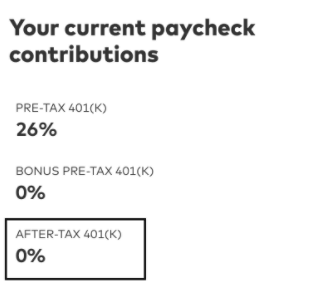
Importantly, don’t confuse it with a Roth 401(k). They’re similar, but different. Small-business owners with a solo 401(k) may also be able to use this strategy if their plan allows.
The MBDR process generally involves two steps:
Depending on your plan, the money may be rolled into either a Roth IRA or a Roth 401(k).
The rules vary from plan to plan. Check your plan documents or summary plan description before enganging in this strategy.
Suppose you’ve already maxed out your traditional 401(k) contribution and completed a backdoor Roth IRA contribution. You now have additional money to invest.
One option is a taxable brokerage account. Another is the Mega Backdoor Roth.
The Roth strategy offers several potential advantages:
A taxable brokerage account also has advantages:
That flexibility shouldn’t be overlooked. Retirement accounts come with restrictions, and those restrictions may matter depending on your goals.
Importantly, some plans allow you to move after-tax contributions to either Roth IRA or Roth 401(k) accounts. A Roth 401(k) may be simpler because some plans offer automatic conversions. A Roth IRA typically offers a wider range of investment choices. It may also provide greater flexibility when it comes to withdrawals.
I generally prefer the Roth IRA option when it’s available. Still, either choice can work well.
After-tax contributions are usually invested while they remain in the 401(k).
If the account earns money before the conversion takes place, those earnings are taxable when moved to the Roth account. For that reason, many investors try to complete the conversion quickly. Some plans even allow automatic conversions.
Suppose you contribute $10,000 to the after-tax portion of your 401(k). Before the conversion occurs, the account earns $100.
You then move the balance to a Roth IRA. The entire $10,100 can be transferred, but the $100 of earnings will generally be taxable if you put it all into Roth IRA. There are plans that allow you to split between Roth and Traditional, which could be helpful.
At year-end, you’ll receive Form 1099-R reporting the transaction.
Using the example above, your tax return would show a $10,100 distribution, with $100 generally treated as taxable income.
If you work with a tax professional, make sure they understand exactly what happened. The reporting isn’t especially complicated, but it should be handled correctly.
The Mega Backdoor Roth isn’t available to everybody. But for those whose retirement plans allow it, the strategy offers a chance to put a substantial amount of additional money into a Roth account and enjoy tax-free growth for years to come.
Have you used this strategy to contribute to your retirement accounts? Let us know in the comments!
 Bogdan Sheremeta is a licensed CPA based in Illinois with experience at Deloitte and a Fortune 200 multinational.
My husband had a few years when he could do the Mega Backdoor Roth. His 401K plan had an automatic conversion feature of after-tax contributions to Roth. That allowed us to build up a little pot of Roth savings. It’s still sitting in the 401K, and he hasn’t tried to move the Roth money into a Roth IRA.
Won’t this trigger the pro-rata rule and become partly taxable if the participant has and will be maxing their non-taxable contributions? Or are 401k balances outside that tax rule? Would it be in their best interest to convert taxable contributions if they are in a high tax bracket?