FREE NEWSLETTER

WHERE YOU PUT your investments can make a huge difference for your after-tax wealth.
As you know, we have 3 main investment accounts:
Asset location
Say, as part of your investment strategy, you want to start putting money in bonds. You have a 401(k), Roth IRA, and a brokerage account. Where do we put them?
Brokerage account
When you hold bonds, like BND (Total Bond Fund ETF), you pay taxes on non-qualified dividends (e.g. interest from the bond) up to a max rate of 37%, plus net investment income tax, if applies. This means that if you receive $1,000 from the bond, you will pay approximately $370 in taxes if you are in the highest tax bracket.
Of course, not all of us are in such bracket, and perhaps a more reasonable number would be ~$220-240 for most people. But is taxable brokerage the right choice for you? Not really. You would be paying $200+ every year, plus state/local taxes.
Personally, I’m 100% invested in equities, because I want to be aggressive with my portfolio in my 20s, but if I did have bonds, I wouldn’t hold them in a brokerage account.
Roth IRA/Roth 401k
When you purchase bonds in a Roth IRA, you will not pay taxes on the interest since it’s a tax-free account!
That’s much better than the $200+ in taxes you would pay in a brokerage account.
But is it the best choice? Well, bonds are considered “fixed income” funds, and they don’t grow much. Since Roth IRA is a tax-free account (meaning we pay no taxes when we sell these investments), we want as much growth as possible in it. Bonds would hinder that performance.
So, holding bonds is better than brokerage, but likely not the most ideal place.
Traditional 401(k)/403(b)
By holding bonds in an account like a traditional 401(k)/403(b), the interest income avoids immediate taxation, compounding tax free until withdrawal.
So, we avoid the ~$200+ of taxes and aren’t sacrificing the tax-free compounding like we are with a Roth IRA. This makes the pre-tax 401(k) the perfect location for bonds.
Of course the 401(k)/403(b) choices are limited and are provided by your employer. So, if they don’t offer a bond fund, you might not have a choice.
Some other examples:
I really like this visual from Fidelity to reference:
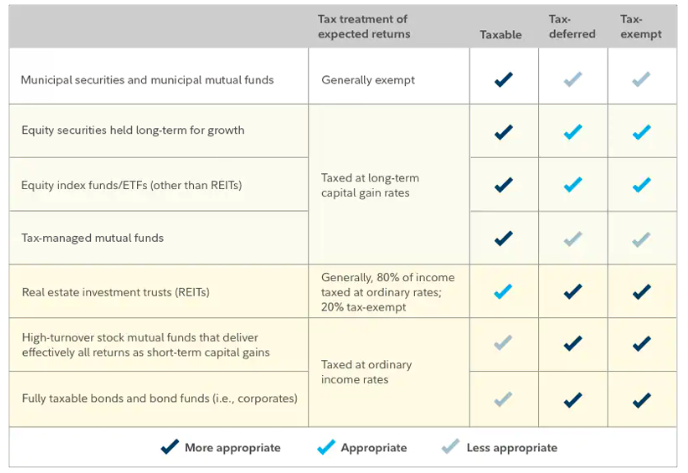
But how much does this matter? Vanguard’s research finds that a thoughtful asset location strategy can add significantly more value than an equal location strategy. The value added typically ranges from 5 to 30 basis
points of after-tax return, depending on circumstances (e.g. income, portfolio size)
Overall, I hope you think about all of your investments & how they get taxed.
 Bogdan Sheremeta is a licensed CPA based in Illinois with experience at Deloitte and a Fortune 200 multinational.
Great analysis, Bogdan, thank you.
We are in the process of converting all of my wife’s traditional to a Roth before claiming Social Security. All of the Roth funds are in 100% in Vanguard Total International ETF. Our portfolio allocation is balanced in our traditional accounts. We are maxing out our income using conversions up to the top of the12% tax bracket. Our tax rate will be the same in the future, but the purpose is to obtain tax free growth with funds that may never be tapped, and thus will be inherited tax free. This will also decrease our RMDs, and allow us to better control our taxable income.
Hi David.
By putting Vanguard Total International ETF (VXUS) in a Roth you cannot claim the foreign tax credit (FTC) even though you are paying foreign taxes. I make a similar decision when I have my Vanguard Global Equity index fund (VTWAX) in my traditional IRA account as my thinking resulted from my decision that I currently prefer the re-balancing simplicity over the modest FTC I am giving up by doing so.
I have been thinking that about five years out from now that when my wife is done with her traditional to Roth IRA conversions that I will then use my unspent (hopefully) RMDs distributions to buy VXUS in a taxable account to be able to claim credit for those withheld foreign taxes and my heirs will eventually be likely to get a step up in basis of those equities in my taxable account.
I would be interested in your thinking and planning to have VXUS in a Roth.